Thursday, February 27, 2020

1, 2, 3

A newly functional room
We've reached the stage in our home renovation where the giant projects are pretty much done, and we're finally able to finish up some minor projects. My brother, Jim, drove up from the Bay Area two weeks ago and helped us install some shelving and the utility sink in the laundry room. That room has transitioned from big-box storage-cave with a narrow passageway wending through, and is now a fully functional laundry room.


Even the towel rack is up.
While Jim and Dambara navigated the shelving and utility sink, I painted and wallpapered the half-bath off the laundry room. After Vihaan put down baseboards, Jim and Dambara installed the vanity, sink, and mirror. That room, too, has transformed, from a gritty-floored narrow-cave to a delightful little powder room.

The best thing about the ongoing nature of home renovation is that we've been forced to live in grimy, icky spaces, and in the case of this house, dog-gnawed door frames and clawed up doors. Each transformative project carries with it immense improvements that we delight in again and again, every time we walk into a room, or turn on a light that didn't exist for months, or a newly useful sink for washing hands or cleaning paint brushes and muddy shoes.

No lights becoming 1, 2, 3 lights.
Speaking of lights that didn't exist, the dining area in our enormous kitchen had no lighting whatsoever. Months ago, we found some pendant lights that we both really liked, so we had them shipped to us, carted them down to Hippo Hardware in Portland for retrofitting from a dangling-chain mounting to a brushed-nickel pipe-mounting, and then they went dormant, languishing on the top of the kitchen cabinets, out of harm's way.


1, 2, 3 oyster-shelled dandelion-heads
Yesterday, Dambara reconfigured his tool belt and started the electrical project of bringing power up from a mystery light switch next to the doorway to span the length of the dining area, and today he anchored, wired, and hung the fixtures. After a quick trip to the hardware store for a dimmer switch, he finished off the last touches, and now we have light over our dining table.

1, 2, 3 lights, all in a row, aglow.

Up next week, Tom and cabinet painting! Our days will be full. Once the kitchen cabinets are painted and the open shelving back in place, we'll be able to step out into spring and focus on the gardens and the farm.

Stay tuned. . .

Sneak preview

Wednesday, January 29, 2020

Asha's Flowers

After the Palo Alto pilgrims left Jerusalem to journey home, Dambara and I were exploring the city around our hotel one morning. We wound our way through one of the street markets, mostly fruits and vegetables and one flower stand. Of course we stopped.

We decided we didn't need any flowers, but wouldn't it be wonderful to bring some flowers back to Asha. We scanned through the numerous varieties, and only one had blue blossoms. Not exactly nayaswami blue, but a nice, violet blue. So we bought one bunch.

They were light to carry, as they swung along in their plastic sheath, safe from bumps and bruises. During the long walk home, we discussed how to deliver them. Should we bring them downstairs to dinner? We could add a bit of water to their bag and hang them on her doorknob. We didn't know her room number. We could get it from the front desk. They might not be allowed to give out guest room numbers. We could call her. She might be in seclusion, recharging between pilgrimages.

So we brought them down to dinner, as the least invasive strategy.

The cafeteria was closed.

There were too few guests in the hotel to warrant opening up the cafeteria buffet, so we ate in the small cafe off the main lobby. Delicious soup. Yummy salad. No Asha.

So the flowers stayed in our hotel room that night.

And the next.

And the next.

When we brought the flowers home, they were tight little buds, perfect for longevity in an elegantly simple vase. Maybe by keeping them longer than expected, it would give them time to blossom into vibrant color. By the time they started to open, their leaves were starting to shrivel slightly along the edges. Plus, they drank a LOT of water, so much so, they spent one afternoon water-free, drooping pathetically around their short, stubby coffee cup, the only vase we had available, completely devoid of elegance.

So they stayed in our room, recovering. Which they did!

They were some kind of poppy-ish flower, with papery petals, long stems, and a burst of leaves just below each blossom, splayed hands announcing "Ta-da". They were a cross between Dr. Seuss and Charlie Brown's Christmas tree. I loved them.

Soon it was too close to the time of our departure for Tiberius, which would create a dilemma for Asha. Should she throw them away or try to carry them through a day of bus travel? I decided I would carry them for Asha. So they stayed in our room, waiting.

I put them back into their plastic sheath, added a half cup of water, and hung them from the back of the bus seat in front of me, Asha's seat, as it happened, and there they swayed along, peering out at the passing country side or dozing in the sun dribbling through the window as the bus waited in successive parking lots while the pilgrims wandered holy sites, listening to Asha whisper in their ears about the spiritual significance of each spectacular church or field or sea.

Finally we and the flowers, shriveled from their sunbathing, arrived at our hotel in Tiberius. As we were waiting for our luggage to trickle out from the depths of the bus's undercarriage, Asha strolled over to smile at us and peer down onto the forlorn flowers peaking, one-eyed, out of their plastic sheath.

"Oh. Huh," she said, politely.

Dambara and I grinned at each other. "These are actually your flowers. We bought them for you last week."

She burst out laughing, appropriately.

"They used to be in better shape, but they were always a bit bedraggled," I explained.

She couldn't stop laughing. "Here are some scrawny flowers for you," she mimicked. "We bought them especially for you."

I should note that Dambara and I were laughing just as much as Asha.

"We were going to leave them on your doorknob, but we didn't know your room number."

"I was in hiding," she admitted.

"We figured as much," I admitted.

"Well, this certainly is a case of it's the thought that counts." She was still laughing,

"Absolutely!" We agreed.

Threading our way through the throng in the hotel lobby, clutched card keys in hand, I ended up sharing the tiny elevator with two, polite Indian men from the pilgrimage. They politely stared at my bag of bedraggled flowers. "They've had a long day of traveling," I smiled. "The bus was a bit hard on them." They nodded politely and smiled politely. "They're Asha's flowers, but I ended up keeping them." They nodded politely. Empathizing. Wise decision, I could hear them politely musing.

I brought the flowers into our hotel room, found them another, non-elegant coffee cup, cut off six inches of their stems, and tucked them into fresh water. They perked right up.

I think they're lovely.

Asha's flowers

Thursday, January 23, 2020

The Power Gap

We are in the gap between two pilgrimages. The first pilgrimage, with Ananda Palo Alto, finished on Sunday evening with heartfelt reminiscences of highlights of our two weeks together in the Holy Land.


At the top of everyone's list, it seemed, was being able to spend time together at many, many holy sites. Time together. That was the highlight for me, too.

Time with dear friends, most of whom we've known for 20 something years, growing alongside each other in our spiritual lives, enjoying being together in prayer, meditation, song, laughter; it's been a magical two weeks.


Listening to Asha, Shanti, and Rami, our Israeli guide, orient us to what we're seeing, where we're going, what we'll be doing. Rami gave us each a Whisper receiver, so Shanti or Asha or Rami could be talking softly in our ears as we stood and gazed or wandered around each lovely destination.

Heaven on earth.

By the time we arrived at our final gathering on Sunday night, we had many, many stories to retell, laughter to reshare, and insights to reveal.

And then we sang, just as we had sung everywhere we went. Practically the entire group was part of the Palo Alto choir, so wherever we went, we sang, and it was glorious. Tandava played the guitar, Dambara played a small keyboard, the rest of us sang. In courtyards, under trees, in churches, in caves, we sang, and we sang.

Asha hugging Rami.
As a going away gift for Rami, we had been practicing two Hebrew songs, on our own for the last several weeks, and then together a couple of times. At the end of our farewell gathering, we stood and sang the Israeli national anthem, in Hebrew, for Rami. Then we sang a popular song, Shalom Lach Eretz Nehederet, Hello You Beautiful Country, which uses the same melody as City of New Orleans. Steven sang the first verse, we all sang the chorus; Dambara sang the second verse, we all sang the chorus; and Tandava sang the final verse, and then we all sang the chorus, several times, clapping, stomping, laughing.

We also sang one of Swami Kriyananda songs, A New Tomorrow, which is actually a hora, so we circled up, back-stepped, kicked, kicked, back-stepped, kicked, around the circle, our amateur rendition of the traditional Jewish dance. What might have been a sad last gathering was instead a rousing, joyful celebration.

People trickled away over the next few days, traveling home, WhatsApp-ing each other across the globe, transitioning back to everyday lives, holding the glow of pilgrimage in their hearts.

Everyone trickled away except Asha, Dambara, and me. Asha is staying because a new pilgrimage has started to trickle into Jerusalem from India, and she will be leading these Indian pilgrims through the same holy sites that we just completed, along with four Ananda leaders from India.

Dambara is staying to bring music into this second pilgrimage. The choir has trickled home, and only a few in the second pilgrimage know the music, so Dambara will anchor the music in a way none of the rest of us can. Singing was an integral part of the inspiration for the first pilgrimage. Of course we wanted to include song in this second one.

The second pilgrimage has its first gathering tonight, just before dinner. Everyone has been traveling all day long, and even though there is only a three-hour difference between Israel and all of India, it is a long journey, and people will be quite tired, ready to rest. We'll gather briefly, have dinner, and then people can go rest.

Tomorrow morning, the journey begins.

So, we've had this four-day gap between pilgrimages. It's been a restful time, a regrouping time, but surprisingly, it's also been a power-gap time.

Forty-some world leaders have been traveling, making their way to Jerusalem, alongside our pilgrims, for a remembrance of the liberation of Auschwitz, 75 years ago today. This meeting will help bring into focus the rising incidences of antisemitism we've seen over the last couple of years, and hopefully acknowledge the worldwide need for constructive action.

The King David hotel on the far left,
Old Jerusalem in the background,
taken from our balcony at the King Solomon Hotel.
The power meeting happens to be taking place at the King David Hotel, which is across the street from the King Solomon Hotel, where we're staying. We've watched the security ramp up as we thread our way along barricaded sidewalks toward the Old City, visiting the same sites where we've spent time during our pilgrimage, and which are now being visited by world leaders. We go in groups of 2 or 4; they go in triple-digit groups.


But it all works! We're free to come and go as we please; they jostle through politely, ambitiously, and it all just works.

I'm finding that a power gap is much better than a soft gap between these two pilgrimages. There's a definitive change in the atmosphere, so that we can move beyond the energy of the first pilgrimage and have a clean slate into which the second pilgrimage can step. The sadness of missing our trickled-away friends has been overshadowed by the power that motorcades past our dining room windows or below our balcony.

The timing is perfect. Our pilgrims are trickling into the King Solomon Hotel just as the world powers are trickling away from the King David Hotel. Tomorrow, the refreshed pilgrims can step into a refreshed Jerusalem, led by a refreshed Asha, singing with a refreshed Dambara.

It's heaven on earth.

Tuesday, January 14, 2020

John, Renouncing All

John, renouncing all, left his home. Some believe that John, son of Elizabeth and Zacharias, guru to Jesus of Nazareth, left his home when he was three years old, going to live in the desert wilderness. Can you imagine? Do you know any three year old who would be able to survive on his own?

King Herod was purging the country of all Jewish baby boys, out of fear of a prophecy that his kingdom would be won by a boy born at that time, into a Jewish household. So, since he was a ruthless, unfeeling king, he simply ordered all Jewish boys be murdered.

Wild John
John and Jesus were born within months of each other. Joseph and Mary fled to Egypt with their son, Jesus. John went into the desert, where he lived by himself for about 30 years. John is often depicted as a wild man, hair gnarled and knotted, eyes wide and delirious. It's easy to believe, too, having lived without a mother's watchful eye and ready wash cloth and comb.

For the past few days, our pilgrimage has been immersed in the suffering of Jesus. The stations of the cross. Dear Lord! The agony. My imagination is too vivid to be able to endure that contemplation. The crucifixion. Peter's trio of denials. The cruelty. The despair.

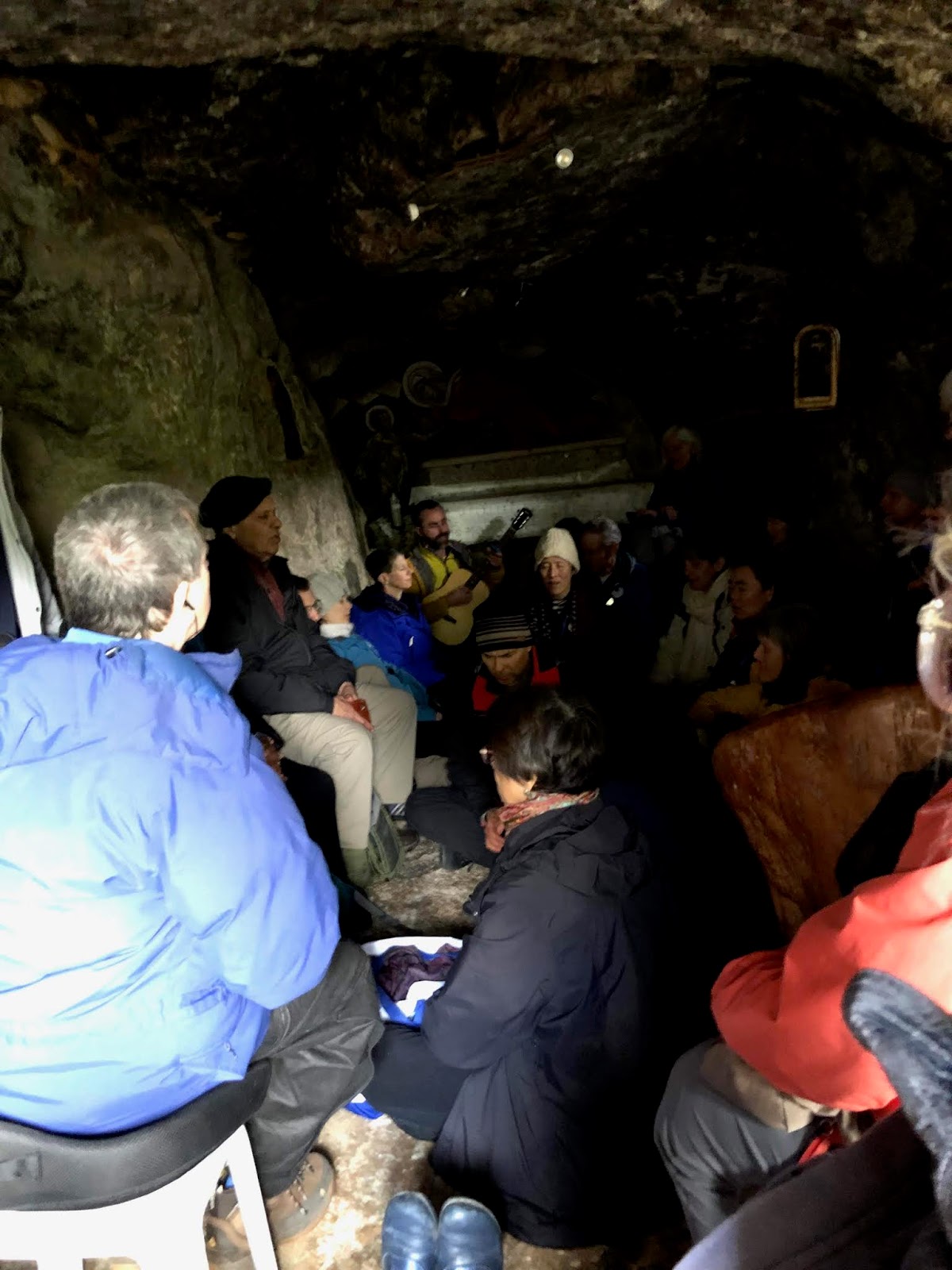
And now today, we come to the story of John the Baptist, focusing on his conception, birth, and solitude. After spending time at the Church of the Visitation, we clambered down a steep path to the cave where John spent much of his life. The site filled his two requirements: a cave for shelter and a spring for water.

An altar inside John's cave.
We jostled and snuggled our way into the cave, all of us just fitting, kneecap to kneecap. We sang and meditated, immersed and contemplated. The air outside was fresh and clean. The camaraderie of devotion inside was deep and profound.

Asha, focusing our meditation on the solitude of John.
John, renouncing all,
Left his home.
Wrapped in solitude,
Far from men's ways.
Roaming across desert sands,
Seeking God's truth.

Long years he spoke only with God,
'Til, silent of soul,
Wisdom did fill the ache of his heart.
Then he did see God alone.


Monday, January 13, 2020

Scared, Sacred Teenager

Imagine a teenager, unexpectedly pregnant, yet because of that pregnancy, poised to fulfill a destiny for which she has been trained her entire life. It's easy to imagine her overwhelmed with tumultuous feelings, including anxiety, disbelief, hope, humility, confusion.

The story of Mary goes back even further though, to her mother, Anne. When Anne was pregnant with Mary, she had a vision that her daughter would be the mother of the messiah. When Mary was very young, three or four years old perhaps, Anne brought her to the Essene temple, to be raised specifically in preparation for that future role. The family was part of the Essene community, that portion of the Jewish people who lived in close accordance to the teachings of the Bible, revolving around the prophecy that the messiah was coming; coming soon.

I imagine that many young girls were raised with the possibility that one of them might be the mother of the messiah, so Mary was probably not alone in her training amid fellow students. The idea of becoming the mother of God would have been a familiar theme to her and everyone around her. And yet other young girls and families held the same expectation of possibility. It would have been easy to think, one of us, someday. . .

And then Mary found herself pregnant, a virgin pregnancy, and the focus of the entire community would have turned toward her.

Can you imagine the shyness, confusion, disbelief that would have swept through her, consumed her?

Thus we come to the visit with Elizabeth. Elizabeth was Mary's cousin, so they would have known each other already. Elizabeth was elderly, and she and her husband, Zacharias, were barren. They, too, had visitations telling them of the birth of a son, a long-forgotten hope, a son who would become John the Baptist.

Mary visits Elizabeth
Elizabeth had lived a long life, immersed in the teachings of the Essene community, with plenty of experience, insight, and wisdom gathered over decades. And now, who should come to her, but a frightened, confused, teenaged cousin, who was pregnant with the messiah.

It was here on this hillside, the location of the present-day Church of the Visitation, at Ein Karem, where Mary and Elizabeth met, both pregnant, both miraculously pregnant; one wise, one innocent; trusted cousins with shared beliefs and understandings; both on the precipice of changing the world, through the sons they carried.

Can you imagine the joy and relief, the awe, they both must have felt? Elizabeth would have wrapped Mary in her arms and said, "You can do this! We can do this! This is real, and it's going to be glorious." And Mary might have said, "I'm so scared. I don't know what to do! I'm not worthy." And Elizabeth might have said, "You will be amazing. You have the support of all who love you. For this moment were you born." Elizabeth would have helped ground Mary, helped her find her footing, stabilizing her for the role into which she was stepping.

And so we spent time at the Church of the Visitation, lifted up by the awe of that ancient meeting on this plot of soil, a site venerated for 2000 years, a small chapel welcoming the daily stream of pilgrims, souls come to touch this spark of divinity, this meeting of two women as they wondered at their entwined destiny, clasping each others' hands, looking into each others' eyes, humbled by the wonder of it all.

Mural at the back of the Church of the Visitation

The entrance to the Church of the Visitation

Wednesday, January 8, 2020

One Responsibility

Asha and Shanti set the perfect tone for our pilgrimage. First, Shanti confirmed that our bus would be leaving for our first day of pilgrimage at 8:30 am. That departure gave us a generous amount of time for a group meditation from 6:00 to 7:00, then breakfast and gathering of stuff from 7:00 to 8:30. She reminded the entire group that some of us are prone to chronic lateness, that we knew who the chronically late were, that everyone knew who they were, and that the chronically late might think about setting their clocks 15 minutes ahead. She said it with great humor and friendship, which made everyone laugh and enjoy the reality that we're all working on our karma, and we're all helping each other succeed.

Swami Kriyananda established the Ananda communities with two principles at the forefront: common understanding and cooperation. In short, if everyone can reach a common understanding, then everyone can cooperate. It's a great partnership.

True to form, Shanti established a common understanding: Be on time for every departure. And, true to form, every last one of us was sitting on the bus at 8:29.

A ride for 40

Second, Asha described that she and Shanti had spent the previous year working out all of the details for the pilgrimage and were in close communication with our tour guide, Rami, the hotel staff, and together they were continuing to take care of all of the details, so we wouldn't have to. Our one responsibility on this pilgrimage was to watch our consciousness.

We are visiting sites of deep holiness, where profound happenings occurred, and where generations of devoted souls have worshipped and touched divinity, across centuries of time. By keeping our hearts open, whether in meditation, conversations with each other, interacting with strangers around us, or coping with weather and fatigue, by maintaining a high consciousness, the power of pilgrimage can change our lives forever.

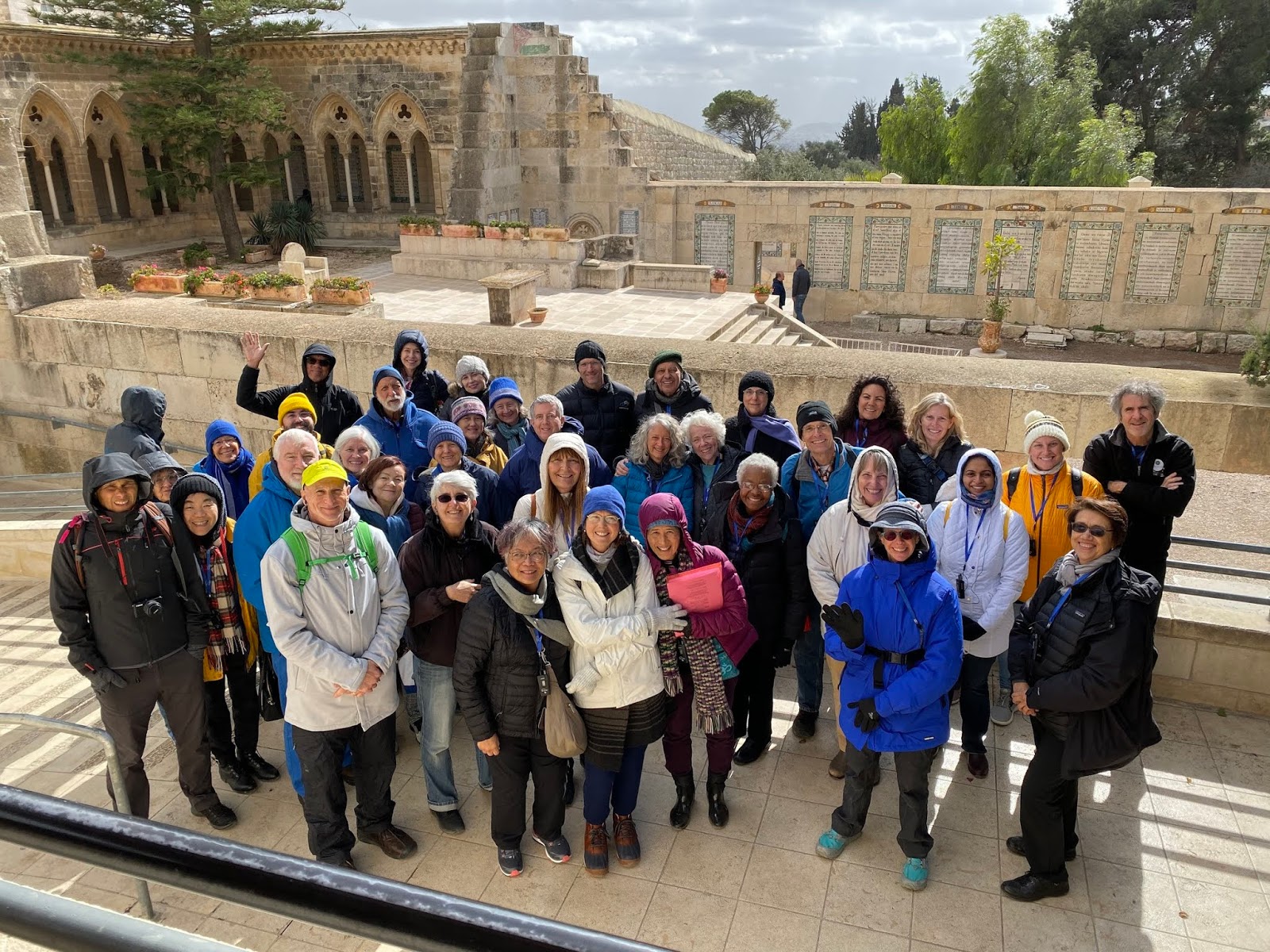
And so, we moved through our day, in friendship, with respect, sharing kindness, meditating, walking, absorbing, immersing, divinely loving. The experience was so deeply moving that I find it hard to put into words. For now, what I can offer are pictures of some of the sites we visited.

Where Jesus wept for Jerusalem
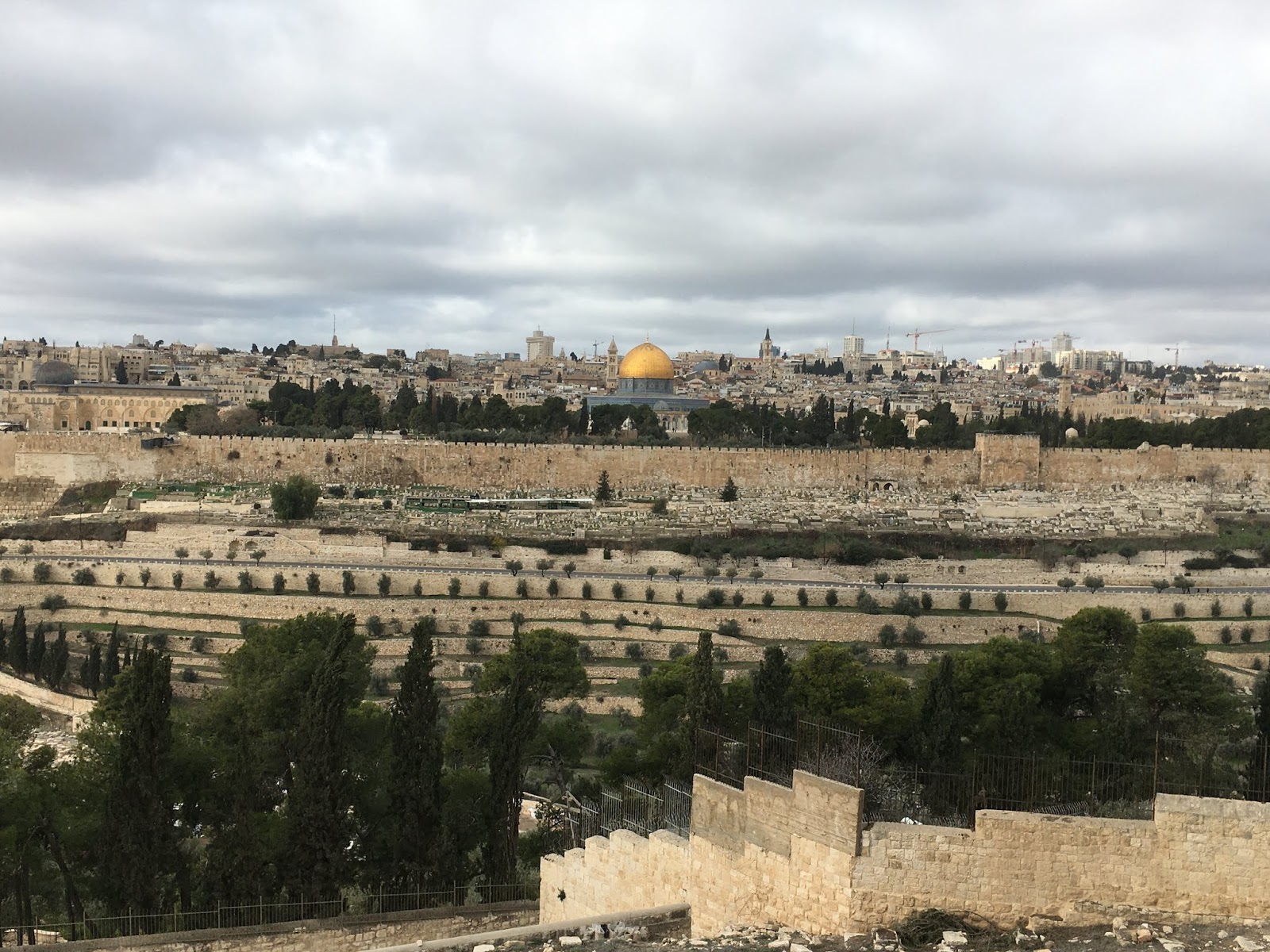
Russian Orthodox church, with the old city of Jerusalem in the background. So many sectors of Christianity, Judaism, and Islam play visible roles in the care taking of these holy sites.

The golden Dome of the Rock, where Abraham prepared to sacrifice his son, Isaac; holy site in Judaism.

The Church of the Sepulchre is the grey dome immediately to the right of and behind the golden dome, and is the location of Jesus' crucifixion, burial, and resurrection; holy site in Christianity.

The grey dome is Temple Mount, the Nobel Sanctuary, where Mohammed ascended to heaven; holy site in Islam.

The Old City of Jerusalem, showing the close proximity of the three sites holy to the three, major, monotheistic religions.

The Church of Pater Noster, the site where Jesus taught his followers how to pray "Our Father"
An olive grove at the Church of Pater Noster, allowing one to imagine Mt. Olive during the time of Jesus.

At Pater Noster, "Our Father" is displayed in more than a hundred languages around the church.

Each unique in style.

Church of All Nations, in Gethsemane Garden, the site where Jesus prayed before his arrest.

The rock on which Jesus prayed in Gethsemane.


You can kneel and touch the rock itself. We were able to stay as long as we wanted.


Tuesday, January 7, 2020

Gathering

We arrived in Jerusalem a couple of days ago, and the greatest fun is running into cherished friends. The pilgrimage officially begins tonight at dinner, although pilgrims have been gathering together, trickling into Jerusalem on individual schedules and varied routes.

There are forty of us all together, and almost every person is a dear friend from our years of living in the Ananda Palo Alto community. Since moving away from the Bay Area eight years ago, we haven't spent much time with these friends, so this pilgrimage is especially meaningful, being able to spend extended time together with so many people that we love.

A walk back in time
We run into them in the hotel lobby, on the nearby streets, in the restaurant, and each new sighting is joyous and celebratory. This morning, a dozen of us gathered in the lobby at 5:30 to walk to the Church of the Sepulchre, twenty minutes away. Along quiet streets, with only an occasional early-morning car humming by, across empty intersections, and through a main entrance of a modern, high-end shopping mall. Walking through the elongated mall, with twinkly lights overhead and chic storefronts on either side, it was a journey through time, wending our way through cobbled passage ways, to emerge at the Jaffa gate to the old city. Just beyond, the high doors of the church beckoned us into a maze of passages, altars, stairs, balconies, tunnels, chapels, and alcoves. It seemed endless and somewhat bewildering.

And yet the quiet of the morning hours were gentle and serene. The first encounter was a stone slab, the stone on which Jesus' body had been anointed with oils, in preparation for placing him in the tomb, or sepulchre. Kneeling next to the stone, you place your hands, forehead, your heart onto the stone and imagine the sorrow with which they cleansed his broken body, binding it in its shroud, carrying it the short distance, measured in yards, really, to the tomb. Meditating at that stone, the site where the cross was wedged into its stone base is mere yards away in one direction, the tomb mere yards away in the other direction. It all happened in such a small area, it could have been a small, barren pasture, just there, there, and finally, there.

Pure devotion
A group of five exquisite singers gather each morning in St. Helena's chapel, around several interior corners and down two flights of stairs. Following each others' lead, we wound our way around and down to this small chapel, the site where St. Helena discovered the true cross, two or three hundred years after the crucifixion, just right there, below the foundations of the inner chapel that was once Jesus' tomb. The five voices blended together clear and pure, softly, devotedly, in harmony and rapture, transporting one's soul into inner light and beauty. We listened to them for perhaps a half hour, and then they were finished, kneeling in silence, then gently turning to gather their belongings and climb the stairs out into the dawn air.

We did not go into the sepulchre itself, out of respect for a tour group, then a full mass, then a long line of waiting visitors. Our hotel is so close by, we will go again and again, in the early hours, and find an even quieter day when we can linger and immerse ourselves in the sanctity of the sepulchre, the glory of the resurrection, and the worship from millions of devoted souls across centuries of time.

Our quiet walk back through the passageways, into the mall, back to modern times, out into the busier streets filled with commuters and bustle, back to our hotel and downstairs to breakfast, to gather together again with this friend, then that one, then newly arrived friends, then another. The pilgrims are gathering, and we will walk this holy journey together.

Farming with a Trowel

I was about six years old when I started tending my first garden. Even then, I loved pulling away the chaotic weeds to make room for orderly...