Showing posts with label creative projects. Show all posts

Wednesday, October 20, 2021

Global Connections

I’m a scientist by temperament and by training. For many years, I worked as a biologist in a pharmaceutical company. Our research department had a sister department located in Japan. Because of this partnership, our lab had a series of visiting scientists from Japan. They were always young people, with a spouse and perhaps with a fledgling family, trying to fit into this foreign place. Since science is internationally interwoven, we had visiting scientists from other countries as well: Australia, Brazil, England, France, Spain, Switzerland, Sweden. They would stay here for perhaps two years, and then return to their own labs in their own countries.


Halloween is a traditional American holiday. It can easily appear silly to people from other cultures. They just don’t quite get it. So every Halloween, my housemate and I would invite the visiting scientists and their families to our home to carve pumpkins. We’d also invite a couple of Americans and their children, to create a balance of experience and bafflement. We’d all sit on the floor throughout the house, newspapers spread in front of us, fresh pumpkins at hand with more on the lawn outside, and tea candles ready next to the front door. We’d start to carve our first pumpkin.

You know, if you’ve ever carved a pumpkin, that it can be a gooey mess. If you’re from another culture, like Japan’s, where food and body are kept very clean and very separate from each other, pumpkin carving could appear completely puzzling, intimidating even. But all of our guests politely started, regardless of inner turmoil, watching nearby friends for clues. The experienced carvers would offer witty advice wherever necessary, and generous encouragement to cautious skeptics.

Imagine the surprise and dismay of opening your first pumpkin and looking down into all that pale orange mess, the strings, the seeds, the oddity of it, the slippery randomness of it. Imagine reaching your hand in and feeling the slime and the endlessness of those inner curves. But looking around, others are doing the same thing, talking and laughing, so you bravely move forward, scooping out the seeds, scraping out the strings, cleaning out your hollow. Okay, now what?  Draw a face??  A scary face???

The first set of jack o’ lanterns are simple and a bit awkward. Two eyes, a mouth, sometimes with teeth, maybe a nose. As each person finishes his pumpkin, he stands up, carries it to the front door, inserts a tea candle, sets the pumpkin in the garden outside, and lights the candle.

Night is falling, and slowly the garden fills with jack o’ lanterns. The candles softly glow, brightly, then even more brightly against the darkening backdrop. The Japanese eyes fill with delight.  The French man grins and scurries off to get his next pumpkin. The Australian scrutinizes the others’ handiwork and tackles his next globe with blooming creativity. The carved faces become haunted, or lecherous, or jeering. Carved flames leap from mouth corners; carved eyes glower. The jack o’ lanterns are no longer consigned to the lawn; now they’re lurking behind rocks, gaping up from under a bush, cackling down from a tree branch.

The transformation is complete, for pumpkins and humans alike. We gather with hot apple cider and wander around the garden, delighted. My Finnish friend puts her arm around my shoulder and says delightedly, “Now I understand Halloween. Now I get it.”

So here I am on the spiritual path.  I have arrived at the party and understand portions of what I’m encouraged to do.  I look around at people I trust and admire, and pay attention to the example they set.  I’m learning that the way to learn is to do.  I’m delving into my pumpkins, each and every one of them, creating the most magnificent jack o’ lanterns that I can.  And I trust that by the time I’m standing in the garden, sipping hot apple cider, watching the glowing faces around me, I will understand why God is expending so much energy to create us, waiting for us to search for Him, and then helping us to find Him.

Monday, October 18, 2021

Irrigation for Camano Summers

I've always thought that the Pacific Northwest had rain all year round. Maybe rain used to fall during the summer season; it doesn't seem to now. Global warming is inching its way up our coast, parching our little farm on Camano Island, a hop, skip, and a jump south of the Canadian border.

We started transplanting all of our flower and veggie seedlings in April, right after our last-frost date, starting with our cold-hardy varieties of onions, lettuces, and cresses. We plowed right along on our transplanting schedule, populating more and more beds with their tiny populace.

And then, the rains stopped early. With thousands of fragile seedlings taking their first breaths in their new beds, we spent hours each week hand-watering those beds. With the beds stretching long, the seedlings raising skinny arms to the sun, and hoses thick and heavy, we teamed waterers with hose managers to navigate the delicate edges of each planting bed.

We had calculated another month before the rains stopped, and so found ourselves suddenly behind on our irrigation-building plan. We shifted gears and, in between hand-watering and transplanting, we built our irrigation systems.

Wobbler warriors.

They were twofold. We needed overhead watering for the tiny seedlings to supplement the main system of drip tapes. Once the seedlings grew large enough, we could abandon overhead watering for the more efficient drip watering. We used wobblers for overhead systems, four wobblers to cover each planting section. We set them up for manual management, since we wouldn't use them for long. 

Connecting drip tape.

Happy seedings. Happy plants.
Separately, we stretched drip tape along the extent of each bed, four tapes for the wider beds, three or even two tapes for the narrower beds. 

Wobblers and drip tape, both.

All of the drip systems are on timers, five timers in all. It's too easy to forget to turn off a sprinkler, or even to turn it on in the first place. With summer drought on our horizon, timers ensured that everyone would have enough water to thrive. Sun, water, good soil, healthy seedlings; a successful formula.

Each timer gets its own post. Prashama is a strong post-pounder.

Then our water pump gave out. We noticed lower and lower water pressure whenever we were hand watering. Drips were smaller and less frequent, all along every drip tape. Our showers dribbled; our washing machine stalled; our water bottles filled languidly.

Then it all stopped. We had no water.

Upon consultation with our cooperative-farm directors, we stretched four, long hoses from the neighboring pump house and hooked it into our water-supply line. Upon consultation with several well-professionals, we eventually replaced our 18-month-old water pump with a new pump. The well-wizzard also hauled an impressive pile of metal debris out of our well, clearing the space for the new pump.

The flower beds under the summer sun.

Thriving.

We continued borrowing our neighbors' water for a few more weeks for the gardens, while our well supplied our household water. We were finally able to switch to our well exclusively, and fingers crossed, we've made it through the drought summer. We still need to install a pressure tank to protect our water pump from all those dripping tapes come next summer, but that's another story for another day.

Wednesday, October 13, 2021

Sowing Seeds to Build Our Farm

We were lucky enough to order our seeds in November, 2020. We had moved through the fearful covid year, with hope dawning in the new year. It was easy to think expansively.

I've grown plenty of veggies in my tenure as gardener, so those seeds were easy. And fun. I've not grown flowers, not many anyway, and only landscape flowers; never cut flowers.

Our main source of inspiration came from Floret Farm. They are only about 45 minutes from our farm, so what worked for them would surely grow on our farm as well. We downloaded their recommendations for the best cut flowers: Focals, spikes, disks, fillers, and airs. We ordered almost all of our seeds from Johnny's and some from Osborne. They all arrived promptly, and I promptly entered overwhelm.

So many seeds! So many varieties! So many colors, heights, support needs, germination times, dates-to-maturity times. I couldn't wrap my mind around it all.

Luckily, I'm a whiz with excel spreadsheets. I painstakingly entered all the relevant information about germination times, transplant-before-last-frost times, heights, and quantities. I let excel do all of the date calculations for me, and then I transferred the varieties onto another spreadsheet organized by weekly, calendar dates.

Everything fell into place. On the biggest sowing week at the end of February, I would have to sow 15 varieties. Other weeks would demand sowing of 5 or 6 varieties. With 7 days in a week, we would have to sow 2 varieties per day during that big week. Most weeks would need only 1 or 2 sowing days. This plan was completely feasible.


Every variety was new to me.

It was feasible in theory, and low and behold, it was also feasible in reality. Joyfully feasible. With our new greenhouse sheltering the growing expanse of seedling trays, my heart grew and expanded. As the seeds germinated, and the tiny seedlings lifted their faces to the warm sun filtering through the greenhouse panels, my heart quite simply exploded.

We opened the greenhouse doors every morning, helping the air stay cool under the spring sun. We closed it every night, helping the air stay still and safe under the spring moon. We watered the trays, seedlings dancing and jostling under the gentle spray. We pinched off stray weed seedlings. We started succession sowings of the seasonal powerhouses, both veggie and flower.

The window vents open and close automatically, according to air temperature.

Our plan was working. Our greenhouse was working. The sun was working. The seedlings were working. Our farm was beginning.

Our self portrait.


Monday, October 11, 2021

A Greenhouse to Withstand the Winds

Creating a small-scale farm in the Pacific Northwest requires creating a greenhouse. The cold of winter lingers. The chill of spring lingers. Then the warmth of summer hits full force, with long days and temperate nights, and then all too soon, the cool of fall descends, and another farming season coasts to an end.

A greenhouse lets us start seeds early, early, early. We can get seedlings going and keep them happy in the daytime warmth of a greenhouse for several weeks. Once we pass our last-frost date, these happy seedlings can go into the ground and turn their faces to the warming sun and burst into serious chlorophyll production.

Original greenhouse site, by the blue tarp.

We had originally planned to build our greenhouse down by the veggie beds. We wanted it to be a pretty greenhouse, so nestled amongst the veggie beds, we would see it whenever we glanced out our windows. And it would be right there! Short trip from greenhouse to planting beds. Made so much sense.

But our planting beds are bordered by mature trees. We realized that the greenhouse would be in the shade by 2:00 in the afternoon during the spring months, those all-important months when the fragile seedlings would need all the light and warmth the greenhouse could muster.

Improved greenhouse site; flat and sunny.

So we changed plans midstream. We relocated the greenhouse site up near our shop, where the ground was super level, and the trees were a considerable distance to the east and west. Our pretty greenhouse would greet friends and neighbors when they came to visit. We could still see it from our windows; we just had to peer a bit.

We have considerable winds on our island. Two or three times a year, storms can bring winds that howl across our property at 50-60 mph. We also get a little snow, so snow load could be a factor. We chose a model that was sturdy enough to withstand our winds and shaped to slough snow.

It was expensive, about $5,000. But I just happened to land an editing gig that would cover the cost. We took the plunge. We had to have a greenhouse if we wanted successful planting beds, and the universe gave us the means to procure the perfect one. We clapped our hands with glee.

We drove two hours to pick up our new greenhouse and they piled and stacked and wedged it into our 20-foot RV. It came in flat packages. It barely fit inside our RV. It had thousands of screws and hundreds of pieces, and they all had to go together just so.

The instruction booklet was sparse and vague. The instructional videos weren't very instructional. We're not builders, but we're pretty clever. We got it figured out, and we finally, finally got it built.

Gravel and crushed-stone pad

Help from our friends.

A ways to go.

The marketing information claimed that two people could build the greenhouse in two days. It took us all of January. ALL of January. We laid down gravel. We laid down crushed rock. We scrutinized, read, videoed, experimented, put together, took apart, climbed ladders, scooted on our knees. One of us came to tears several times. One of us stayed calm and cheerful. We persevered, and we finally, finally got it built.

Thousands of screws, with tension pulling in several directions.

Light at the end of the tunnel.

Our farm cooperative, gathering to ooohh and aaahh.

Busily growing seedlings.


Never, never have I ever, ever had such a wonderful venue for sowing seeds, peering at germination, watering seedlings, crooning, and grinning. The greenhouse made our farm possible. I am in joyful love with our pretty, enduring, nurturing greenhouse.


Ready to grow a farm.

Friday, October 8, 2021

Flower Beds

As we finished up the planting beds that we laid out in the pasture to the west of our house, I began counting on my fingers. These beds were huge, in my experience, but our list was huge-er. Where would we put the flowers?

An easy glance over our shoulders offered the obvious solution. Our shop was situated on the opposite side of a gully from our house. Between the shop and the gully was a gentle, south-facing slope that was obviously perfect for flower beds. They would get so much sun. We would see them from our windows. They were right next to the shop, which housed our tools. There were two water-hydrants already in place. It was obvious.

The obvious choice.

I was at a loss as to how to orient the flower beds. How wide? Which direction? How many? I brainstormed with friends and husband, staring at the slope from our deck, imagining. It wasn't obvious.

Then, one sunny winter day, I walked along the slope, along the edge of the shop, along the driveway. I got out some stakes, twine, and a hand sledge and started marking off a pathway along the shop, wide enough for frequent foot and cart traffic. I marked off the slant of the gorge, the stretch of driveway, the most direct route between house and shop. It all became obvious.

We could fit nine beds on that slope, 45 feet long, which echoed the length of our first set of beds, and 3 feet wide, for ease of flower harvesting. The paths could be narrow, since these flowers wouldn't sprawl. We'd trim back the maple tree that did sprawl across the center of our slope. It all took obvious shape.

We ordered more straw and dairy compost and mowed the pasture grasses and weeds that had crammed themselves onto that gentle slope. We dealt out the compacted straw pads, spread 5-6" inches of dairy compost, covered with fabric cloth, bird netting, and zigzagged twine, and stepped back to take a look.

A direct path between house and shop.

Laying down straw, topping with compost.

The diagonal layout dictated by the gorge left a large, empty triangle next to the driveway. We could put perennials there.

We spread cardboard, burlap bags, and wood chips, and left the flower beds to work on their winter steeping.

Fabric, netting, and burlap in place for the winter.

Wood-chip paths and tilthed beds in the spring.
The triangle bed completes the layout.
With 14 veggie beds steeping to the west of the house and 10 flower beds steeping on the shop's slope, we were ready for spring.

Friday, October 1, 2021

First Beds

Our new house was surrounded by pasture, pasture that had been mowed and mowed and mowed. Underneath the over-mowed pasture was sandy sand. Our native soil can't hold water, can barely support grasses and pasture weeds, and is full of rocks. Luckily, most of the rocks are friendly, being smallish and round; leaden ping pong balls, snuggled into their bed of sandy sand.

Not much can grow in this native soil.

25 yards makes a huge pile.

There's a roadside sign along the highway as you drive onto our island. "Garden compost, $15/yard." Feeling adventuresome, we called the number, and sure enough, our local dairy farmer would bring his dump truck to our property, filled to the brim with 25 yards of dairy compost.


There was hope.


Lovely, lovely straw, ready to become soil.


Another local source delivered 20 bales of straw. We had the makings of healthy soil that would feed the microbes and worms and an entire universe of burrowing beings. We rolled up our sleeves.


This bounty arrived mid-summer. We had visions of a fall garden, burgeoning with cabbages and squash and onions. We were ready.

However, the dairy compost was hot. The high nitrogen would cook any tender seedlings we handed over to its care.

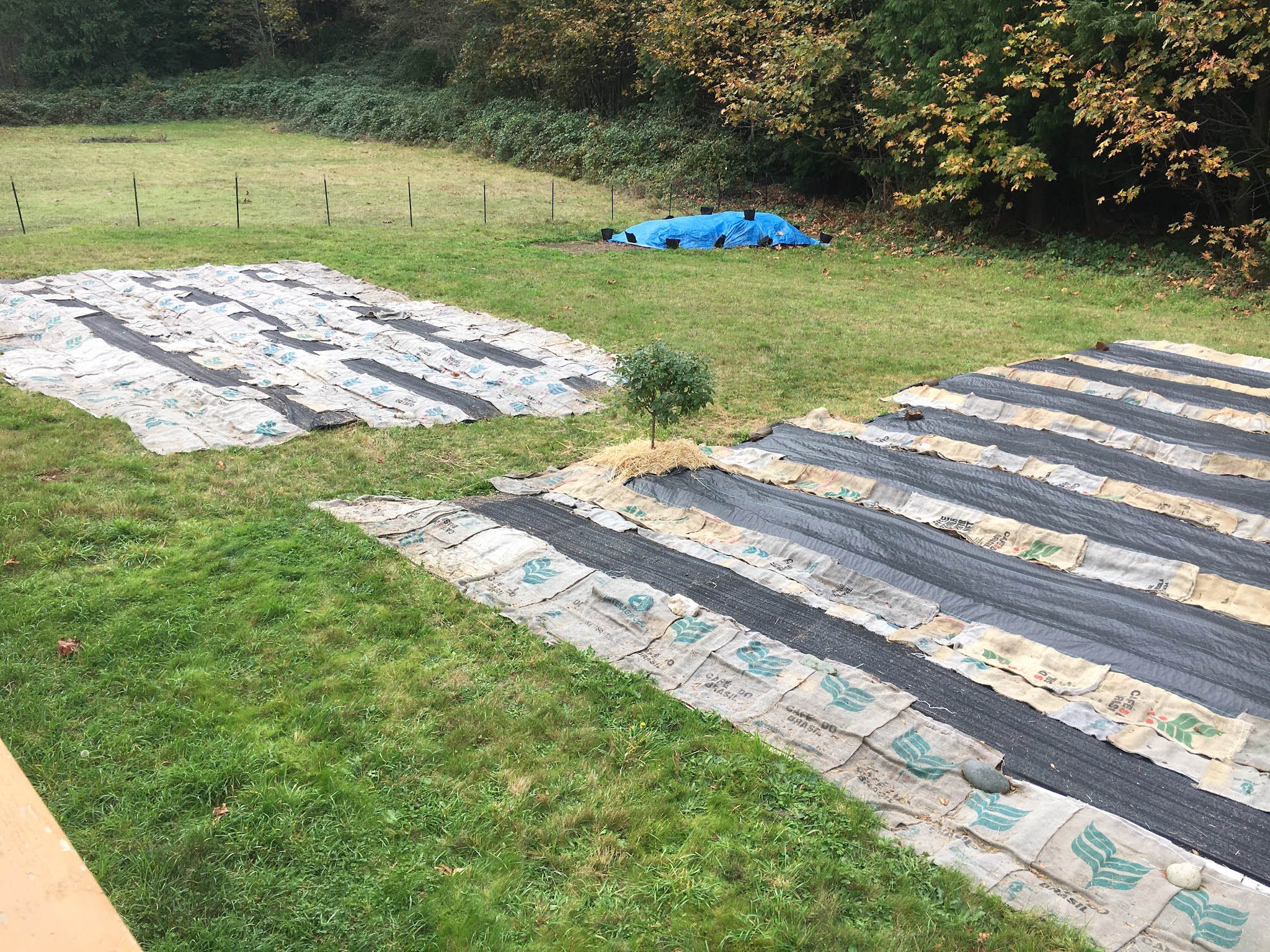
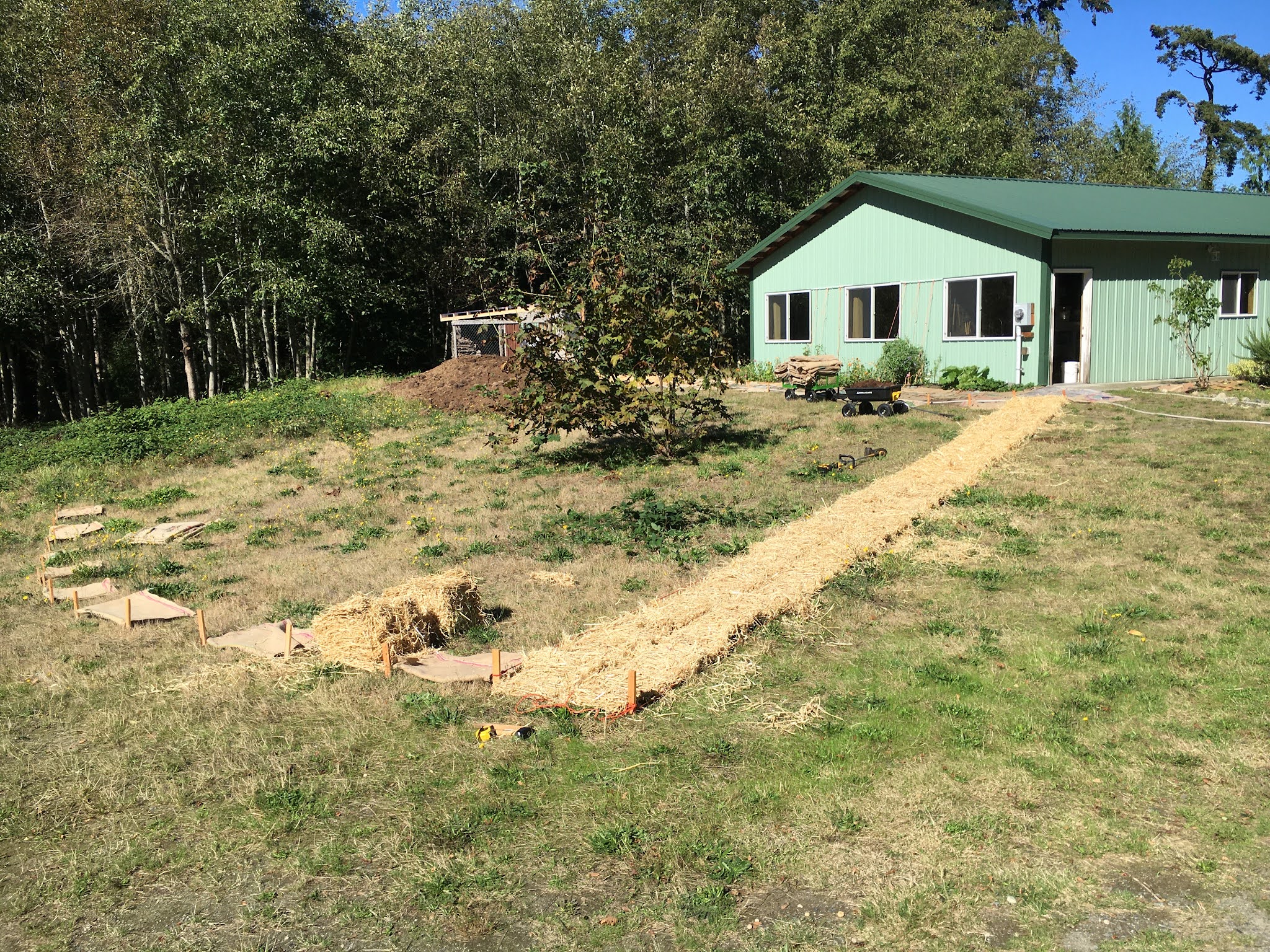
Undeterred, we refocused our lens and looked toward spring. We pried apart pads of compacted straw from each bale, nestled them cheek-by-jowl onto our newly mown pasture, creating ten beds, 4 feet wide and 45 feet long, with a wide central walkway.

The planting beds take shape.


Ten beds, leaving room for a greenhouse.


We carted our hot compost and piled it, 6 inches deep, onto the 5 inches of straw pads, and watered it all down.


Our hopeful scheme for keeping the landscape cloth in place.

To deter fall weed seeds from setting up house on these inviting stretches of richness, we covered each bed with landscape cloth, holding the edges down with burlap bags.
It looked a mess, but we knew that each bed would cook over the winter and be ready for spring planting in just a few months.


In the meantime, we needed worms.

Build it, and they will come.

They did. In droves.

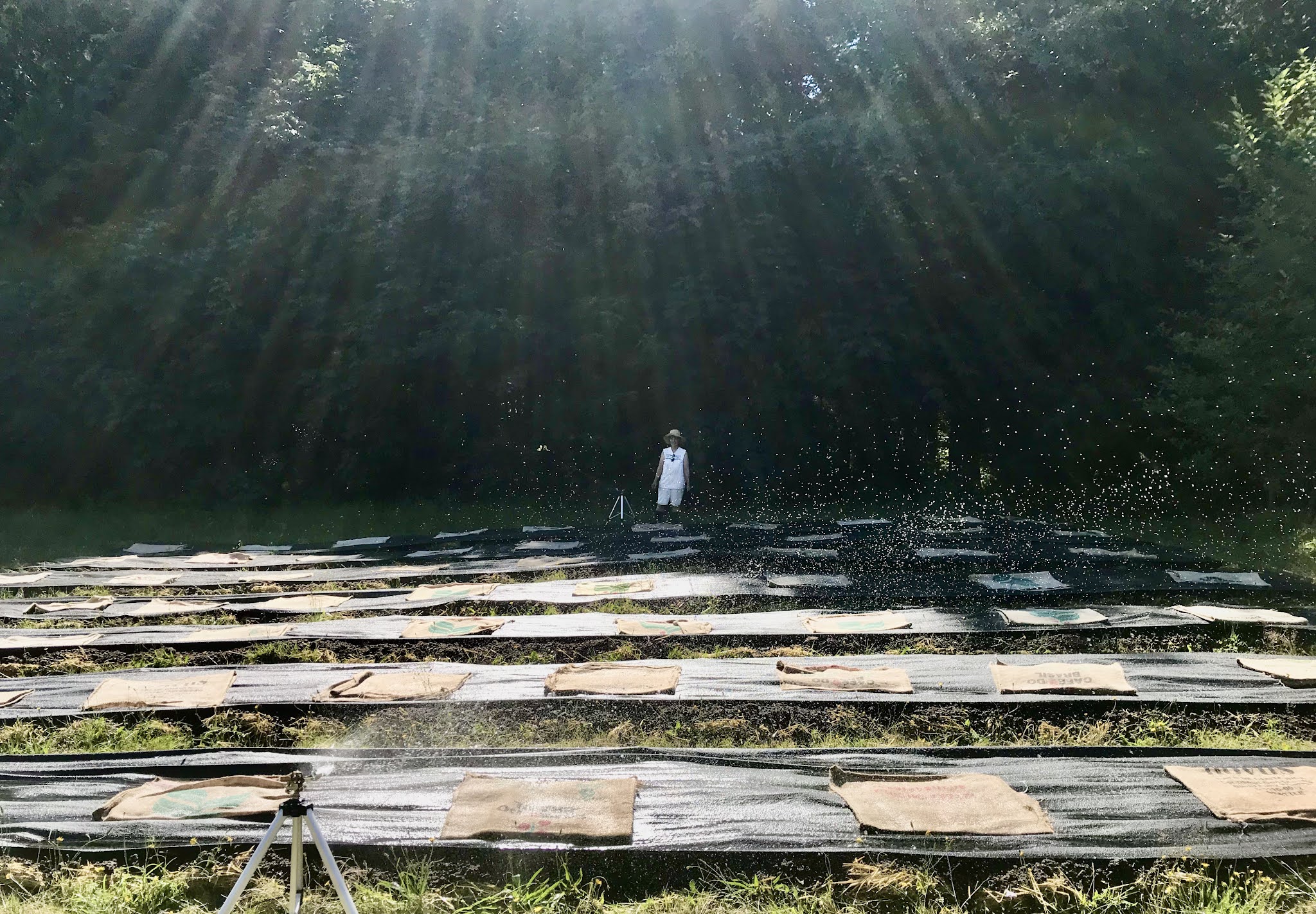
The first watering.

Monday, May 4, 2020

Sheltering in Place

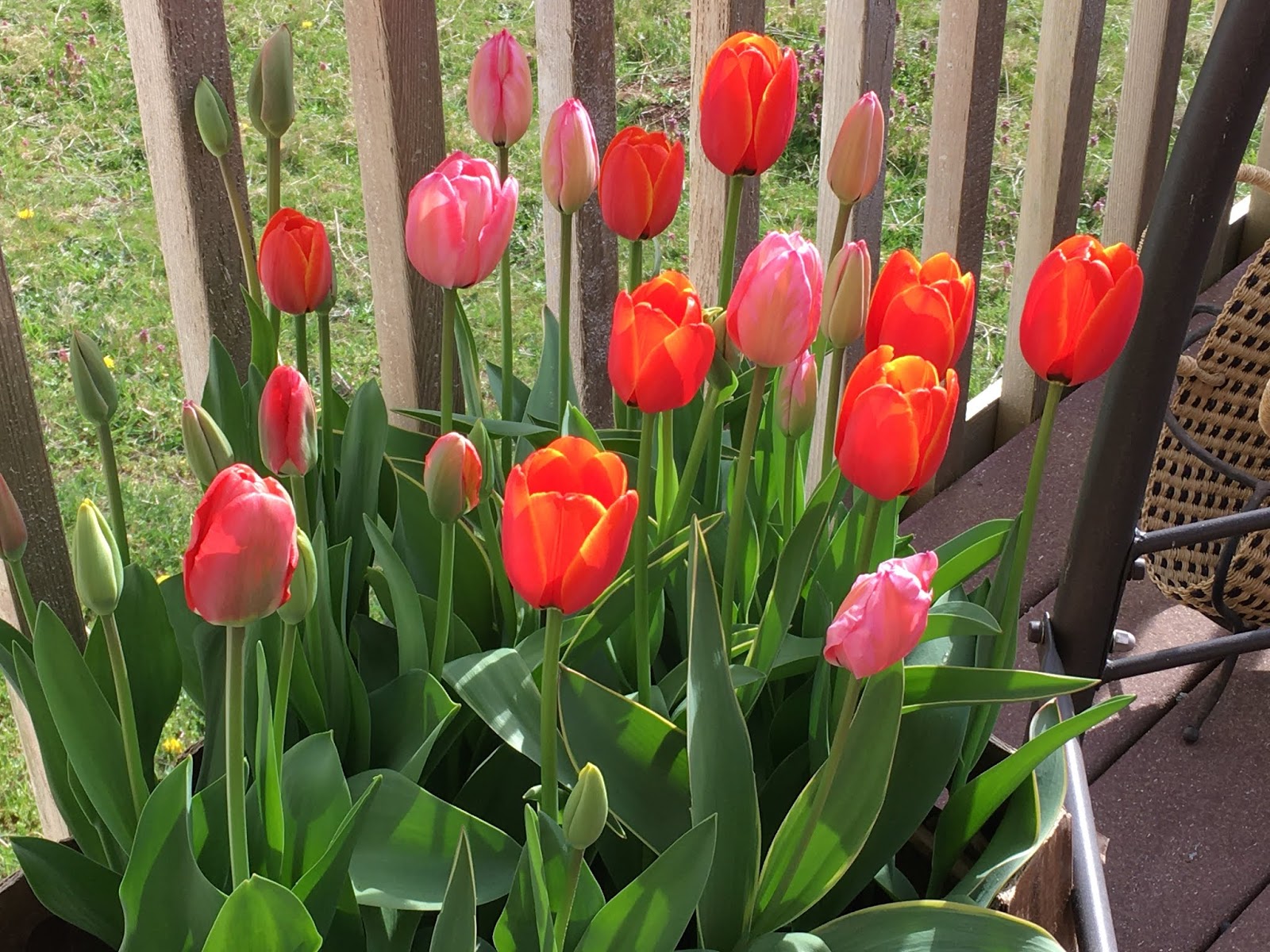
Last fall, we brought home some bulbs to plant in anticipation for spring blooms. There were some hurdles between then and now, including renovating the house so we could move in, then further renovation to bring out its beauty, then stormy weather, then missing power cords, then traveling to Jerusalem, so the bulbs never made it into the ground.

They were finally planted in some empty celery boxes, which work perfectly, since the boxes are waxed and can stand up to extended moisture. All of the daffodils fit into three boxes, and the tulips went into a fourth box, with the remaining tulips finding a cozy, dank, dark home at the base of our still-potted apple trees.

The boxes of blooms sit in sunny spots, protected from strong winds, waiting it out until next fall, when surely, surely, we'll have the wherewithal to get them into the ground. They are sheltering in place.

Happy crowd

Sheltering in place

Our household has been sheltering in place quite cheerfully. We have each other for company and occasionally spend distanced time with the other farmers. From time to time we make forays into town to pick up supplies. We've been learning how to cook foraged food, discovering great recipes as well as the sporadic not-so-great recipe, who enjoys doing which errands or tasks or projects or chores. Some things get done right away. Other things don't need doing, as it turns out.

We've watched favorite movies, jig-sawed a puzzle, painted, weed-whacked, trimmed, sprouted, and attend almost-daily ooh-aahh tours, to admire each others' progress on the things we're discovering that we love to do. Mixed in there is planning a flower farm, writing a book, renovating a neighbor's house, harvesting farm produce, creating a temple, clearing an acre or so of blackberry bramble, uncovering a chicken coop, which is now our bike shed, and a chicken yard, which is now our firewood storage, and a huge hole in the ground, which would make a fabulous duck pond.

We are dreaming and doing and enjoying and being. And we are not alone.

There has been an impressive array of shelter-in-place projects that have flowed across our screens, entertaining and inspiring our fellow humans around the globe.

Juilliard students and alumni put together a stirring rendition of Bolero.

John Krisinkski, AKA Jack Ryan, reports on Some Good News every week.

Hallelujah brings a congregation closer, at a distance.

You can find makeup advise, from England.


Ski adventures on the floor.

An operatic family.

Animals at home in thick, urban jungles.


Hundreds and hundreds more all speak to the fact that we are an amazing species, that we can get through anything, and that the planet will heal itself, whenever we're able to let it.

And because today is today, may the fourth be with you.

Saturday, May 2, 2020

Finishing Touches

Years ago, Dambara and I spent 4 weeks in India, on a pilgrimage led by Asha Nayaswami, David Praver, and Durga and Vidura Smallen. About 35 pilgrims traveled around northern India, visiting places mentioned in the Autobiography of a Yogi, central to our spiritual path. We stayed in very nice hotels because it helped all of us recharge at the end of each day to come back to comfortable rooms, fabulous food, and hot showers.

Many of the hotels were luxurious; some were modest. All of them had one common aspect: neglected edges.

One hotel in particular stands out in my memory. We stayed in Badrinath, at the very northern tip of India, a stone's throw from Tibet, for two nights. It was a bone-rattling journey to and from, in jeeps that clattered along a breath-depriving, narrow, dirt road that was vaguely scratched out along the treacherous steepness of the Himalayan mountain sides. We arrived, drained from hours of terror, and checked into our rooms.

The hotel was very high end, with en suite rooms, tall windows, expansive dining room, and beautiful, marble slabs lining all of the walls, everywhere. But the hotel felt neglected to me, unfinished, untidy. It took me a while to realize that it was because all of the edges were unfinished.

Along the hallways, banquet rooms, dining hall, the beautiful marble flowed down the walls to meet the beautiful marble of the expansive floors. The jagged edges of the walls met the jagged edges of the floors, and those jagged junctions were dusted with bits of rubble, grit, and dust. It felt as though the hotel was still under construction, but it had been in operation for two years. It was finished.

Spring blooms, check!


Years earlier, traveling with a friend through Greece, again and again we had to pick our way past rubble scraped up against the side of enormous buildings; banks, office buildings, apartment buildings. Again, it felt like a construction zone, and yet on closer examination, it was obvious that the rubble had lain there for months, perhaps years. The ornate buildings were opulent, gorgeous feats of architecture, with high-end businesses and residences, but the attention to detail ended before it considered the unfinished edges. There they persisted, neglected and ignored.


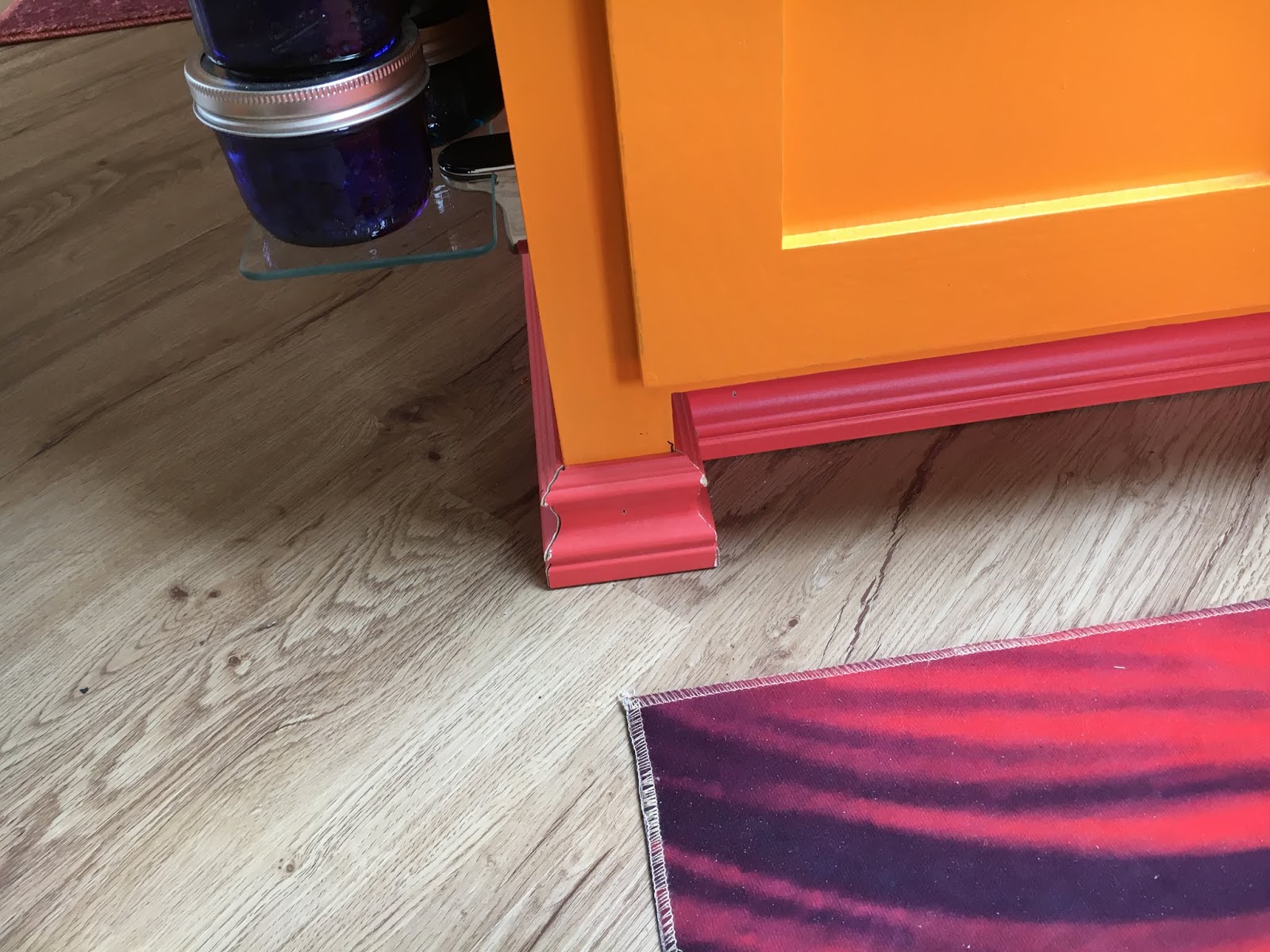
Baseboards, check!


Edges are an important part of finishing touches. The renovation at Haven West doesn't feel complete until the edges are complete. The beauty and magnetism of the rooms blossom into being with the finishing touches that occur to one or the other of us.


Toast and bread counter, check!


And as the work spaces become more useful, we come across things in drawers or out of boxes that would make that spot prettier or easier to use. It's a work in progress, a creative process.


Outlet plates, check!
 We continue to surprise each other with creativity and thoughtfulness. Form and function cooperate to transform every corner of the house into spaces that we enjoy using, spending time in, sharing friendship and laughter.

It is a wonderful world.

Spice shelves, check!


Thursday, April 30, 2020

Nested Horizons

An artist in Aptos, CA, fills her studio with fabric art. She took her love of fabric and her husband's love of flying small planes and created a plethora of landscapes created with softly colored fabric, layered to portray the view from a small plane. Small planes fly at a lower altitude, so you see more details of the landscape below you. Lower altitudes also are rich in the phenomenon of nested horizons, the vista of a series of receding mountain ridges, colorful and detailed in the foreground, dimming in color and detail as they fade into the distance.

I fell in love with nested horizons in her Aptos studio and experienced them myself when I flew small planes, decades ago. You can also see them driving through the Central Valley of California and from many vista points along highways and hiking trails. Nested horizons speak to the soul of soaring like a bird, freely floating across the landscape, an immersion into something far larger than yourself. Nested horizons can evoke a spiritual experience that soothes your soul and expands your consciousness.

I dabbled with nested horizons a bit when I was doing a lot of watercolor. But I was never transported by the landscapes I was able to create with my limited knowledge and experience with watercolor. The paint dried too fast. The detail was hard to capture. The crispness of the ridge lines was hard to maintain with successive layers of paint. It became tedious rather than transformative.

As it turns out, all that needed to happen was a change in medium. As it turns out, wall paint works wonderfully well.

Nested horizons
In the kitchen at Haven West, we keep our small appliances on a butcher block table, all of them set up and ready to use. The wall behind the butcher block is quite high, perhaps 11 feet. It's a big, blank expanse of wall, or a big, blank canvas, depending on how you look at it. It was waiting for something of interest to display. I was looking for something creative to lift my spirits.

Enter nested horizons.

We had plenty of paint left over from our kitchen-cabinet project, plus some tan and blue left from painting the bathroom. All of the colors were enamel, so they had a soft sheen to them, setting them apart from the flat peach of the kitchen wall.

The colors went up in order of increasing vibrancy, enhancing the visual of receding into the background. The household voted for jagged ridge lines, since the Cascade and Olympic ranges visible from Camano Island are dramatically jagged. It was easy to sketch out and easy to paint, because I could concentrate on the crisp edges without worrying about the paint drying before I could fill in the middle.

Even though it cost me a week in bed with muscle spasms from my craning neck, I would do it again in a heartbeat. It was so much fun and turned out so pretty.

Second coat for the tangerine range
Everyone in the household helped out. Dambara installed the remaining shelves for the wall. Celeste Sophia pulled three, unused cable boxes out from the wall. Vihaan installed baseboards and patched and painted the empty cable-box holes. Celeste Sophia added under-the-shelf lighting and a painted edging for the shelf, shielding our eyes from the lighting and helping the shelf to blend into the nested horizons. She also painted the cord for the lighting and the brackets for the shelf, helping them blend into the background, too. Celeste Sophia and Vihaan tackled the dangling electrical cords from all of the appliances and brought them into coherency and invisibility.  As a final touch, Dambara added Waldo.

We all oohed and awed as the various elements fell into place.

And now we have a beautiful work station for juicing and mixing and baking and chopping. A perfect project for a drizzly week.

Find Waldo

Tuesday, April 28, 2020

Napkin Cubby

Years ago, decades actually, I visited Paris with a friend, and we ended up having lunch in an antiquated restaurant across from the Sorbonne. A curved countertop in the corner served as wine bar and cashier station. Along the entire arc of the curve, from elbow to floor, ran stacked rows of small doors, each door perhaps 3 inches wide and 6 inches tall, with a petite knob allowing one to open each door. I asked the proprietor about the story of the doors, and she explained that they were napkin cubbies.

A couple of hundred years ago, when the restaurant was a hub for the scholastic neighborhood, regular patrons would supply their own cloth napkins. Between meals, the patron would stash his or her napkin in the assigned napkin cubby, a nicety of the modest dining establishment that allowed a flair of sophistication for the meal. The stacked rows of cubbies provided convenient storage, and the little doors, and the camaraderie of the clientele, provided assurance that your napkin would be waiting for you at the next meal.

I was enchanted. So, of course, Haven West has its own napkin cubby.

Napkin cubby

It's a cute little thing, and it has its own story. But before I tell you that story, perhaps I should explain my preoccupation with cloth napkins.

When I was in high school, way back in the 70s, our principal hired a new history teacher who also taught ecology. No one had heard the term before, but here he was, and he managed to teach all of us the concept of the environment and our role in it. Our senior class project was to plant trees. We knocked on doors throughout the neighborhoods belonging to our high school and asked the homeowners if they would like to have a new tree planted in their parking strip, free of charge.

The city provided the trees and sent a tree-hole digger to all of the addresses where people had said, "Yes, please!" For a few Saturdays in the early spring, me and my classmates roamed the streets and planted the waiting trees into their waiting holes. Mr. Hicks single-handedly launched the environmental movement in the former-orchard city of San Jose, CA.

Needless to say, the concept of ecology and environment made a huge impression on me. And so, when I moved into my first apartment the day after high school graduation, one of the first things I did was to make cloth napkins. I had just helped plant 500 trees. Now my job was to reduce the number of trees that were being cut down to make paper. Cloth napkins helped me do that.

Napkins in Waiting

Fast forward fifty years; I'm still making cloth napkins, and I've persuaded the Haven West household to use them. Our visitors use them, too.

But if you have to wash, dry, fold, and replenish all the napkins after every meal, it becomes tedious, people lose interest, and paper napkins start to creep into daily routines.

Enter the memory of the antiquated, Parisian restaurant with its stacked rows of napkin cubbies. We needed napkin cubbies.

Enter the furniture sale at Living Wisdom School. When first I saw the mailboxes needing a new home, mailboxes that most likely used to live in the school office, I thought it might be useful to stash things for people living in our house as well as houses on the rest of the farm. Forgotten sunglasses and clippers could find safe, temporary lodging in this stack of convenient mailboxes. So Dambara and I brought it home.

Drab, brown, plywood mailboxes

It happened to be the drab brown that old wooden furniture tends to attain, without the beauty of fine wood shining through. It was drab, brown plywood. But! we had paint.

Primed cubbies and hand, as it turned out
Cheerful, leftover paint
There are a lot of cubbies in the mailbox, and as I primed and painted, that memory of the Parisian restaurant kept trickling into my thoughts. I wondered if this could be a napkin cubby for our household. Would everyone roll their eyes or be enchanted?

Enchanted.

So, we have a napkin cubby, with pretty cloth napkins, and everyone enjoys this tiny notch in the crusade to save trees.

Mr. Hicks would be so proud.

Enchanting napkin cubby

Farming with a Trowel

I was about six years old when I started tending my first garden. Even then, I loved pulling away the chaotic weeds to make room for orderly...