Showing posts with label prayer. Show all posts

Monday, October 25, 2021

Fear!

This is a post I wrote seven years ago, about a beautiful place where we used to live.

We've started on our fall to-do list, and one of the major projects that had sifted its way to the top of the list was our pond. The cattails had migrated out into the center of the pond, threatening a silent take over of the open water. The surrounding grasses had towered and toppled, shrinking the perimeter by about 5 feet, all the way around the circumference. Our pond was disappearing back into the wilderness.


The pond returning to its wild state

We opened the outflow valve and gave it a couple of days for the water to drain onto the pasture, and then we were ready to go. It was pretty mucky work. I started about 30 minutes before Dambara returned home, and had pulled up about 20 cattails before he got there. In the process, I had managed to smear muck across my teeshirt and all up and down my work pants. My gloves were coated, and my boots weighed about 10 pounds each. Muck was in my hair, and I was wearing randomly applied, muck war-paint.

Dambara strolled up to the pond, all dressed up in his town clothes, best leather shoes, crisp white shirt and assessed the situation. He grinned and said, "I'll go change and give you a hand." I grinned back and said, "Actually, I'm finding that it's a surprisingly tidy job. I don't think you'll need to change."

"Ha, ha, ha," said my wise husband, and he turned around to go change.

The shape of the pond starts to emerge
So we worked together a couple of hours, and then went back the next day for another round. We made good progress.

We perched on the bank, carefully choosing solid footing so as not to slide the muddy soil down into the pond, deteriorating the structure of the bank. Neither of us wanted to wade out into the muck, though. I had made a brief excursion, sank about 6 inches into the black goo, then gingerly squelched back to safety.

So from our sloped perches, we reached out as far as we could, sweeping the next cattail into grasping range, and pulled, with occasional success. But we certainly weren't getting them all. We knew that if we just let them go, next year they'd march out even further, taunting us from the safety of deep water, quickly engulfing the entire pond.

Why were we so tentative about venturing out into the water? Why didn't we just tromp out there and dig them up? Two reasons: Dambara is a very tidy person. He remained a crisp, clean contrast to my muck-smeared facade, even though he was working just as hard and being just as efficient as me. But he wasn't predisposed to wade, possibly disappear, into the seemingly bottomless muck.

And me? Me, I'm afraid of water.

I can swim. I love to jump into pools. I camp along streams and walk along wave-tossed beaches. But murky, uncharted, mysterious bodies of water? They are foreboding and threatening. A tail-twitching panther starts pacing around inside my ribcage, snarling, and I have to back off.

And so we called it a day and tromped back to our safe, dry, cozy house, took showers, and made dinner. Ahhh.....

The next day, I was on my own. Dambara was out of town and would actually be gone for the next six weeks. I had to either get those cattails out by myself, or leave them for next fall when we could drain the pond again. Not much choice, really. I reluctantly threaded my way back up to the pond, gravel rake in hand. Maybe I could snare the roots with this long tool and pull the cattails, one by one, over to the bank. I squished my way around the perimeter, inching my way to the defiant cattails, boots sinking, the muck grabbing my heels, threatening to swallow me whole.

Clasping overhanging grasses, I was able to keep upright all the way to the far side of the pond, where the cliff face plunged directly into the water, making further progress impossible. Impossible for me, at least. I faced the center of the pond and the jeering cattails and reached out with my gravel rake.

It worked like a charm! The cattails were rooted in the muck, so with only a jiggle or two of the rake, the roots pulled easily out of the water. I reached, jiggled, and pulled about 20 cattails over to the bank, then grasping them stoically to my once again muck-smeared chest, hauled them out of the pond onto the top of the bank. Ha! With fresh determination I squelched my way back to tackle the next batch, concentrically further out of reach.

I reached . . . . and could just barely snag the far away root. I jiggled the rake. It barely moved. I reached a little further and jiggled. I could not loosen it. And my back was starting to hurt, dramatically cantilevered as I was. Not enough jiggling and not firm enough of a stance for effective pulling. Sigh. This would be so much easier if I would just step out there and stand right over each remaining cattail.

And so I did.

The panther inside my ribcage had curled up and gone to sleep. Squelching along the bank and jiggling all those roots had helped some deep part of me realize that this wasn't so threatening after all. The pond wasn't bottomless. Not even the muck was bottomless. I had waded into my fear far enough to discover that the reality wasn't nearly as perilous as my imagination had led me to believe.

I figured that I could always retrieve my boot if the muck grabbed it too resolutely. The water was only twelve, eighteen inches deep. It would flood my boots, but what the heck. The water was surprisingly clean. Muddy, yes, but not decayed, rotting, odiferous goo. I realized that I probably wouldn't die.

I pulled one booted foot out of the muck along the bank, stepped out into the water, and let that foot sink. Water poured over the top of my boot, and then the sole hit solid ground. Huh. I pulled my other foot out of the bank's muck, lowered it, let the boot flood, then set it down, also on solid ground. Ha! The muck was only along the bank! The bottom of the pond was solid clay, and my boots sank maybe not at all. The panther in my ribcage started laughing and turned back into my heart.

I victoriously moved from cattail to cattail, used my rake to jiggle their roots, and easily pulled out every single one. There were criss-crossed runners, and it was easy to reach down and use both hands to jiggle and pull, feel which runner was under which, sort them out, and bring up every rootball. I threw the uprooted cattails up onto the bank, moved onto the next, even cleared out the roots we had precariously trimmed from the bank, and mounded the whole mucky mess up onto the bank.

I pulled up a couple of poorly placed reeds, scooped out encroaching grass roots, unearthed, or unmucked actually, an ancient, disintegrating, reel-to-reel tape, smoothed out a ragged outcropping, and then clambered back onto the grassy bank. My heart was singing, the cattails lay chastened, scattered along the bank, and our pond was ready to go for another three years.

Almost full after one rain storm

And my fear? Well, I know the panther will be there again, pacing, the next time I'm cornered, but I also know that when I finally figure out a way to step into the fear, the reality will be easier than remaining stuck in the muck of my imagination.

It's okay to be afraid. I simply have to avoid being afraid of being afraid. That's where the panther prowls, and where I'll be victorious the next time, and the time after that.

Friday, October 15, 2021

Planting Seedlings Early, Late, and Just in Time

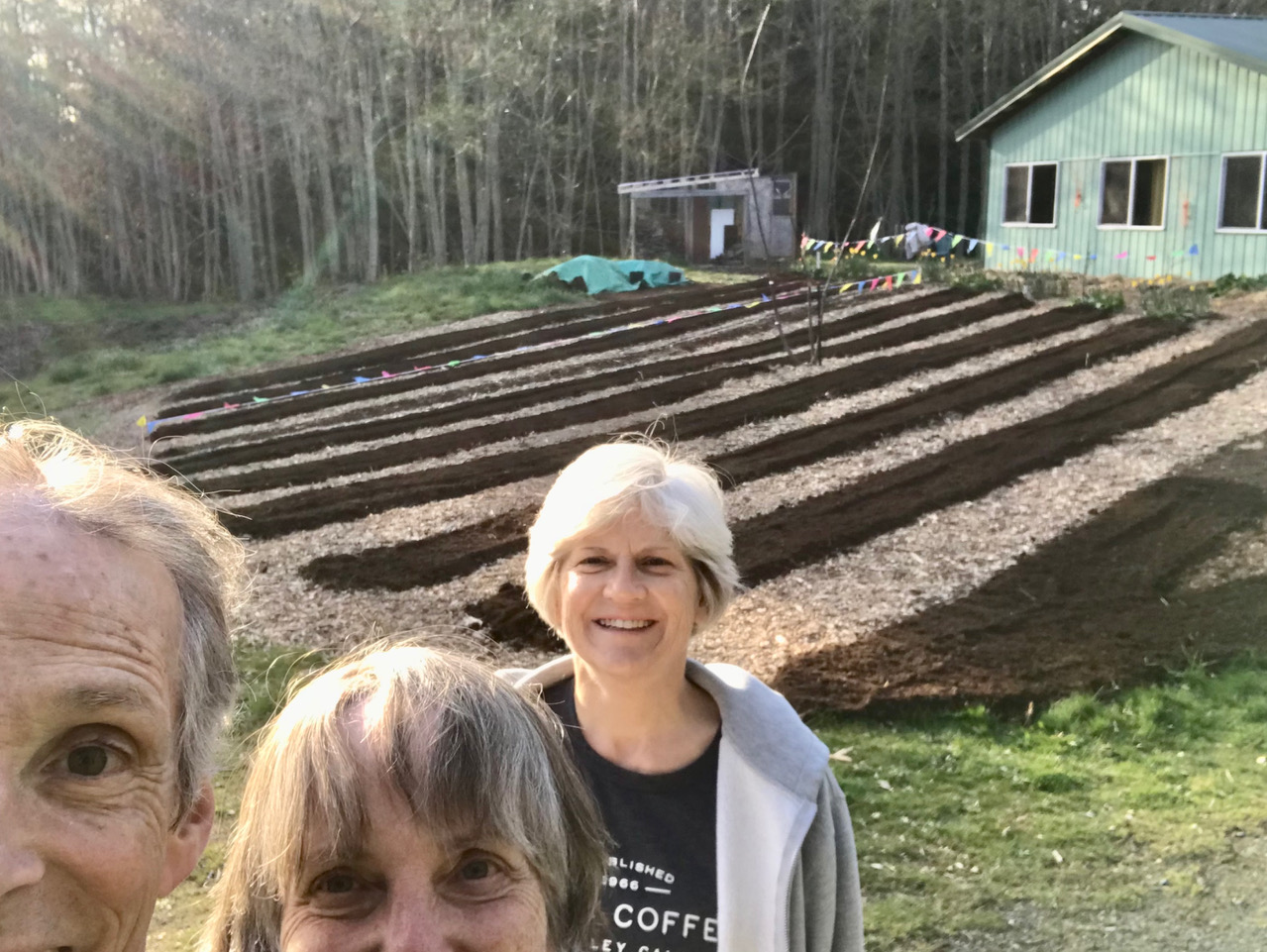
There are times when two people cannot contribute enough hands to get the job done. We were extraordinarily blessed in the spring of 2021, when our friend, Dora, offered to come and help us get our planting beds up and running.

Dora at the prana table.

There were a few preliminary projects. We had to remove the bird netting, roll it up, tying each bundle securely, and stashing them away. Ditto for the landscape fabric, the twine, the fabric staples, the rocks, the branches.

Our hard work paid off.


As we unzipped each bed, it seemed clear that our over-wintering strategy had worked. The beds were pretty much weed-free. We scattered some soil supplements and tilthed the top layer of compost, mixing everything together easily and neatly.


We had two types of seedling trays. We had set our sights on using a paperpot transplanter that we had inherited from a friend. In theory, we could transplant 256 seedlings in less than a minute. I had used it successfully in another garden and was enthusiastic about our success in getting all of our transplants into their beds.

Unfortunately, the straw underlayment had not broken down completely. It caught in the furrower of the transplanter, and hiccuped our progress into frustration and despair. Luckily, Dora and Dambara were able to persevere, and they got all of the paperpot seedlings into the ground.

We also had 50-cell tray seedings. Each seedling went into the ground as we scooted our way down the beds. With three of us scooting, we were able to get all of these seedlings into the ground as well.

We up-potted many of the seedlings, to allow them to gain size and resiliency before going into the ground. Especially the sprawlers, the squashes and cucumbers, would benefit by being older when they went into the ground, when the days and nights were warmer.

The veggie beds, a month into transplanting.
The three of us got it all done. But we had adversaries: one pint-sized and a trillion pea-sized.

The robin who owned our veggie meadow delighted in pulling up our fragile seedlings. He didn't eat them; he merely pulled and dropped them, gasping, at the cusp of their former lodging. He did this over and over, and we determinedly followed after him, replanting the gasping youngsters.

It was the trillions that worked faster than we could. Pill bugs. Trillions of them. They had overwintered, snug as a bug in a rug, under our brilliant solution of landscape fabric, feasting our our brilliant solutions of straw, compost, and wood chips.

We lost 90% of our onions, shallots, and leeks, and most of our spinach and lettuces. There were trillions of them. They didn't care for cilantro or arugula, asparagus or carrots, so we had many successes, too.

Flourishing flower beds.

Researching strategies for combatting pill bugs: Eliminate all decaying straw, wood, and compost. Well. Then we'd be back to native soil, so those strategies won't help. Spraying: Not part of our farming strategy. The one that would work: Transplanting older seedlings so they can outgrow the munch rate of the pillbug hordes. I'm thinking it will also help if we eliminate the winter covering of landscape fabric. That's a happy thought, since keeping the fabric in place was a huge pain last winter.


Transplanting older seedlings also eliminates the paperpot transplanter. That's actually okay, too, since that allows us to use straw again this winter to help further build our soil.

So. We learned a lot. We accomplished a lot. We conquered a lot. And if it hadn't been for Dora, it wouldn't have happened. Dora saved our spring and our farming year. Thank you, thank you, Dora. You are a jewel.

A jewel of a friend.

Tranquility.

Thursday, January 23, 2020

The Power Gap

We are in the gap between two pilgrimages. The first pilgrimage, with Ananda Palo Alto, finished on Sunday evening with heartfelt reminiscences of highlights of our two weeks together in the Holy Land.


At the top of everyone's list, it seemed, was being able to spend time together at many, many holy sites. Time together. That was the highlight for me, too.

Time with dear friends, most of whom we've known for 20 something years, growing alongside each other in our spiritual lives, enjoying being together in prayer, meditation, song, laughter; it's been a magical two weeks.


Listening to Asha, Shanti, and Rami, our Israeli guide, orient us to what we're seeing, where we're going, what we'll be doing. Rami gave us each a Whisper receiver, so Shanti or Asha or Rami could be talking softly in our ears as we stood and gazed or wandered around each lovely destination.

Heaven on earth.

By the time we arrived at our final gathering on Sunday night, we had many, many stories to retell, laughter to reshare, and insights to reveal.

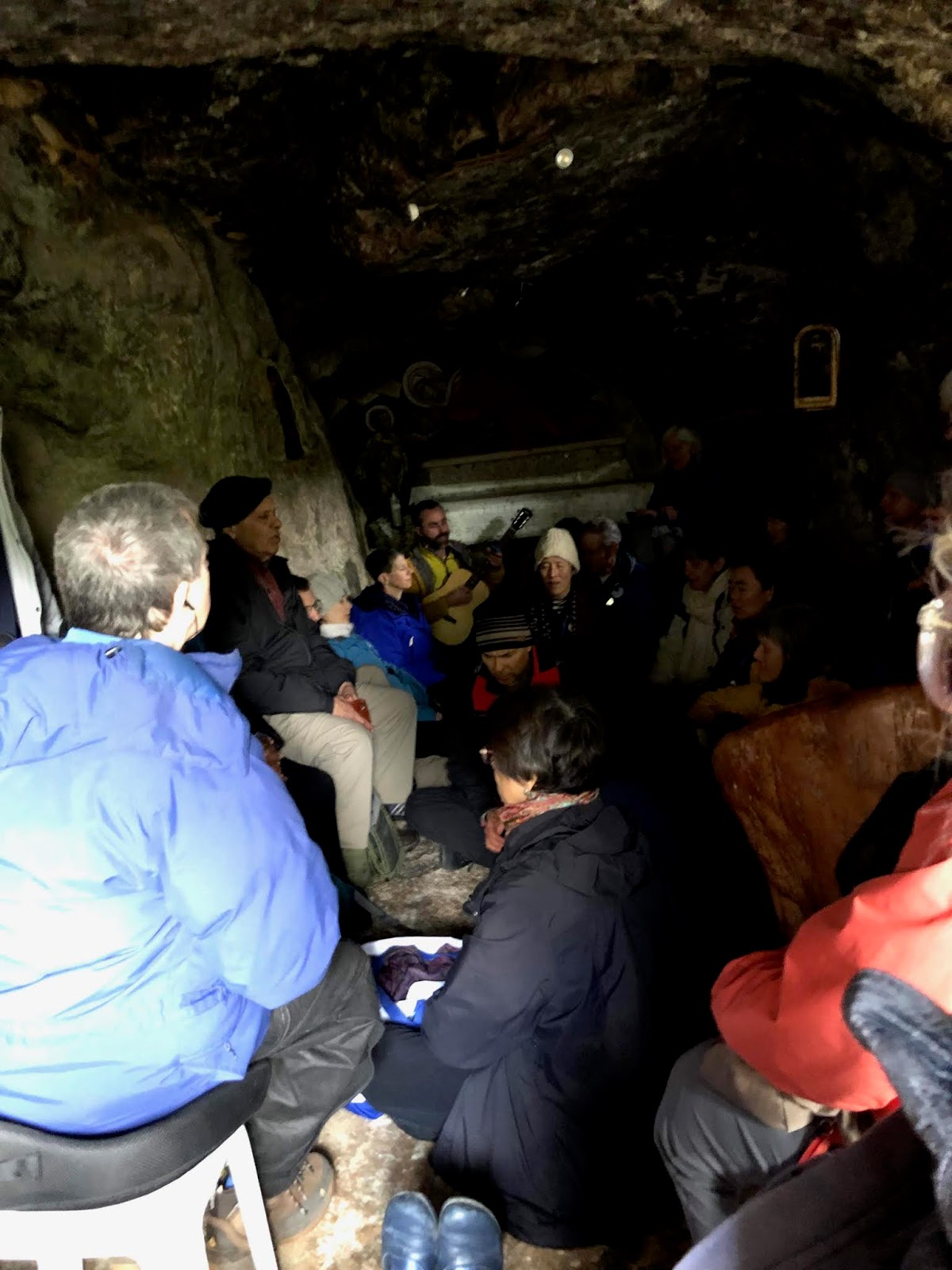
And then we sang, just as we had sung everywhere we went. Practically the entire group was part of the Palo Alto choir, so wherever we went, we sang, and it was glorious. Tandava played the guitar, Dambara played a small keyboard, the rest of us sang. In courtyards, under trees, in churches, in caves, we sang, and we sang.

Asha hugging Rami.
As a going away gift for Rami, we had been practicing two Hebrew songs, on our own for the last several weeks, and then together a couple of times. At the end of our farewell gathering, we stood and sang the Israeli national anthem, in Hebrew, for Rami. Then we sang a popular song, Shalom Lach Eretz Nehederet, Hello You Beautiful Country, which uses the same melody as City of New Orleans. Steven sang the first verse, we all sang the chorus; Dambara sang the second verse, we all sang the chorus; and Tandava sang the final verse, and then we all sang the chorus, several times, clapping, stomping, laughing.

We also sang one of Swami Kriyananda songs, A New Tomorrow, which is actually a hora, so we circled up, back-stepped, kicked, kicked, back-stepped, kicked, around the circle, our amateur rendition of the traditional Jewish dance. What might have been a sad last gathering was instead a rousing, joyful celebration.

People trickled away over the next few days, traveling home, WhatsApp-ing each other across the globe, transitioning back to everyday lives, holding the glow of pilgrimage in their hearts.

Everyone trickled away except Asha, Dambara, and me. Asha is staying because a new pilgrimage has started to trickle into Jerusalem from India, and she will be leading these Indian pilgrims through the same holy sites that we just completed, along with four Ananda leaders from India.

Dambara is staying to bring music into this second pilgrimage. The choir has trickled home, and only a few in the second pilgrimage know the music, so Dambara will anchor the music in a way none of the rest of us can. Singing was an integral part of the inspiration for the first pilgrimage. Of course we wanted to include song in this second one.

The second pilgrimage has its first gathering tonight, just before dinner. Everyone has been traveling all day long, and even though there is only a three-hour difference between Israel and all of India, it is a long journey, and people will be quite tired, ready to rest. We'll gather briefly, have dinner, and then people can go rest.

Tomorrow morning, the journey begins.

So, we've had this four-day gap between pilgrimages. It's been a restful time, a regrouping time, but surprisingly, it's also been a power-gap time.

Forty-some world leaders have been traveling, making their way to Jerusalem, alongside our pilgrims, for a remembrance of the liberation of Auschwitz, 75 years ago today. This meeting will help bring into focus the rising incidences of antisemitism we've seen over the last couple of years, and hopefully acknowledge the worldwide need for constructive action.

The King David hotel on the far left,
Old Jerusalem in the background,
taken from our balcony at the King Solomon Hotel.
The power meeting happens to be taking place at the King David Hotel, which is across the street from the King Solomon Hotel, where we're staying. We've watched the security ramp up as we thread our way along barricaded sidewalks toward the Old City, visiting the same sites where we've spent time during our pilgrimage, and which are now being visited by world leaders. We go in groups of 2 or 4; they go in triple-digit groups.


But it all works! We're free to come and go as we please; they jostle through politely, ambitiously, and it all just works.

I'm finding that a power gap is much better than a soft gap between these two pilgrimages. There's a definitive change in the atmosphere, so that we can move beyond the energy of the first pilgrimage and have a clean slate into which the second pilgrimage can step. The sadness of missing our trickled-away friends has been overshadowed by the power that motorcades past our dining room windows or below our balcony.

The timing is perfect. Our pilgrims are trickling into the King Solomon Hotel just as the world powers are trickling away from the King David Hotel. Tomorrow, the refreshed pilgrims can step into a refreshed Jerusalem, led by a refreshed Asha, singing with a refreshed Dambara.

It's heaven on earth.

Monday, January 13, 2020

Scared, Sacred Teenager

Imagine a teenager, unexpectedly pregnant, yet because of that pregnancy, poised to fulfill a destiny for which she has been trained her entire life. It's easy to imagine her overwhelmed with tumultuous feelings, including anxiety, disbelief, hope, humility, confusion.

The story of Mary goes back even further though, to her mother, Anne. When Anne was pregnant with Mary, she had a vision that her daughter would be the mother of the messiah. When Mary was very young, three or four years old perhaps, Anne brought her to the Essene temple, to be raised specifically in preparation for that future role. The family was part of the Essene community, that portion of the Jewish people who lived in close accordance to the teachings of the Bible, revolving around the prophecy that the messiah was coming; coming soon.

I imagine that many young girls were raised with the possibility that one of them might be the mother of the messiah, so Mary was probably not alone in her training amid fellow students. The idea of becoming the mother of God would have been a familiar theme to her and everyone around her. And yet other young girls and families held the same expectation of possibility. It would have been easy to think, one of us, someday. . .

And then Mary found herself pregnant, a virgin pregnancy, and the focus of the entire community would have turned toward her.

Can you imagine the shyness, confusion, disbelief that would have swept through her, consumed her?

Thus we come to the visit with Elizabeth. Elizabeth was Mary's cousin, so they would have known each other already. Elizabeth was elderly, and she and her husband, Zacharias, were barren. They, too, had visitations telling them of the birth of a son, a long-forgotten hope, a son who would become John the Baptist.

Mary visits Elizabeth
Elizabeth had lived a long life, immersed in the teachings of the Essene community, with plenty of experience, insight, and wisdom gathered over decades. And now, who should come to her, but a frightened, confused, teenaged cousin, who was pregnant with the messiah.

It was here on this hillside, the location of the present-day Church of the Visitation, at Ein Karem, where Mary and Elizabeth met, both pregnant, both miraculously pregnant; one wise, one innocent; trusted cousins with shared beliefs and understandings; both on the precipice of changing the world, through the sons they carried.

Can you imagine the joy and relief, the awe, they both must have felt? Elizabeth would have wrapped Mary in her arms and said, "You can do this! We can do this! This is real, and it's going to be glorious." And Mary might have said, "I'm so scared. I don't know what to do! I'm not worthy." And Elizabeth might have said, "You will be amazing. You have the support of all who love you. For this moment were you born." Elizabeth would have helped ground Mary, helped her find her footing, stabilizing her for the role into which she was stepping.

And so we spent time at the Church of the Visitation, lifted up by the awe of that ancient meeting on this plot of soil, a site venerated for 2000 years, a small chapel welcoming the daily stream of pilgrims, souls come to touch this spark of divinity, this meeting of two women as they wondered at their entwined destiny, clasping each others' hands, looking into each others' eyes, humbled by the wonder of it all.

Mural at the back of the Church of the Visitation

The entrance to the Church of the Visitation

Wednesday, January 8, 2020

One Responsibility

Asha and Shanti set the perfect tone for our pilgrimage. First, Shanti confirmed that our bus would be leaving for our first day of pilgrimage at 8:30 am. That departure gave us a generous amount of time for a group meditation from 6:00 to 7:00, then breakfast and gathering of stuff from 7:00 to 8:30. She reminded the entire group that some of us are prone to chronic lateness, that we knew who the chronically late were, that everyone knew who they were, and that the chronically late might think about setting their clocks 15 minutes ahead. She said it with great humor and friendship, which made everyone laugh and enjoy the reality that we're all working on our karma, and we're all helping each other succeed.

Swami Kriyananda established the Ananda communities with two principles at the forefront: common understanding and cooperation. In short, if everyone can reach a common understanding, then everyone can cooperate. It's a great partnership.

True to form, Shanti established a common understanding: Be on time for every departure. And, true to form, every last one of us was sitting on the bus at 8:29.

A ride for 40

Second, Asha described that she and Shanti had spent the previous year working out all of the details for the pilgrimage and were in close communication with our tour guide, Rami, the hotel staff, and together they were continuing to take care of all of the details, so we wouldn't have to. Our one responsibility on this pilgrimage was to watch our consciousness.

We are visiting sites of deep holiness, where profound happenings occurred, and where generations of devoted souls have worshipped and touched divinity, across centuries of time. By keeping our hearts open, whether in meditation, conversations with each other, interacting with strangers around us, or coping with weather and fatigue, by maintaining a high consciousness, the power of pilgrimage can change our lives forever.

And so, we moved through our day, in friendship, with respect, sharing kindness, meditating, walking, absorbing, immersing, divinely loving. The experience was so deeply moving that I find it hard to put into words. For now, what I can offer are pictures of some of the sites we visited.

Where Jesus wept for Jerusalem
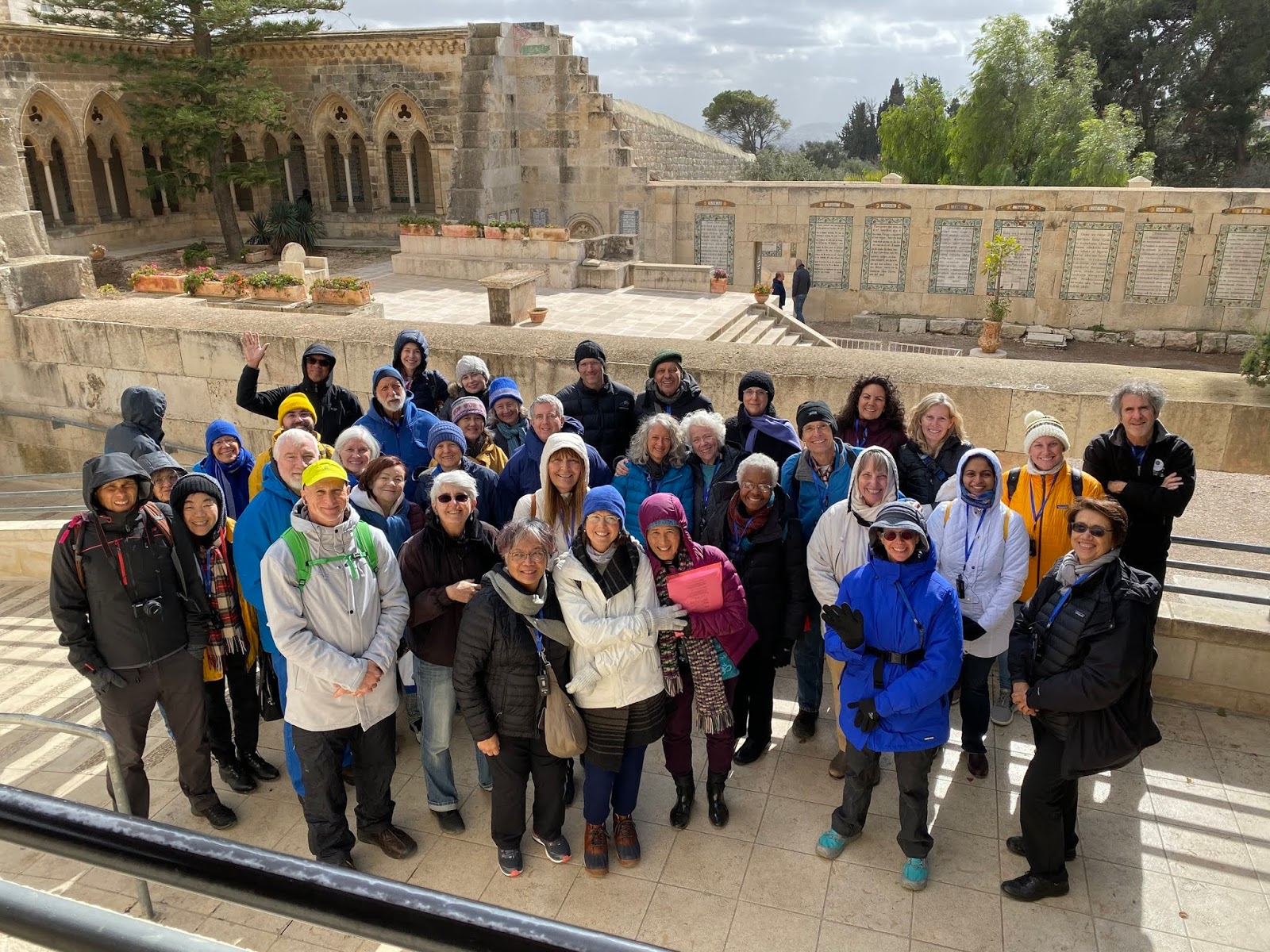
Russian Orthodox church, with the old city of Jerusalem in the background. So many sectors of Christianity, Judaism, and Islam play visible roles in the care taking of these holy sites.

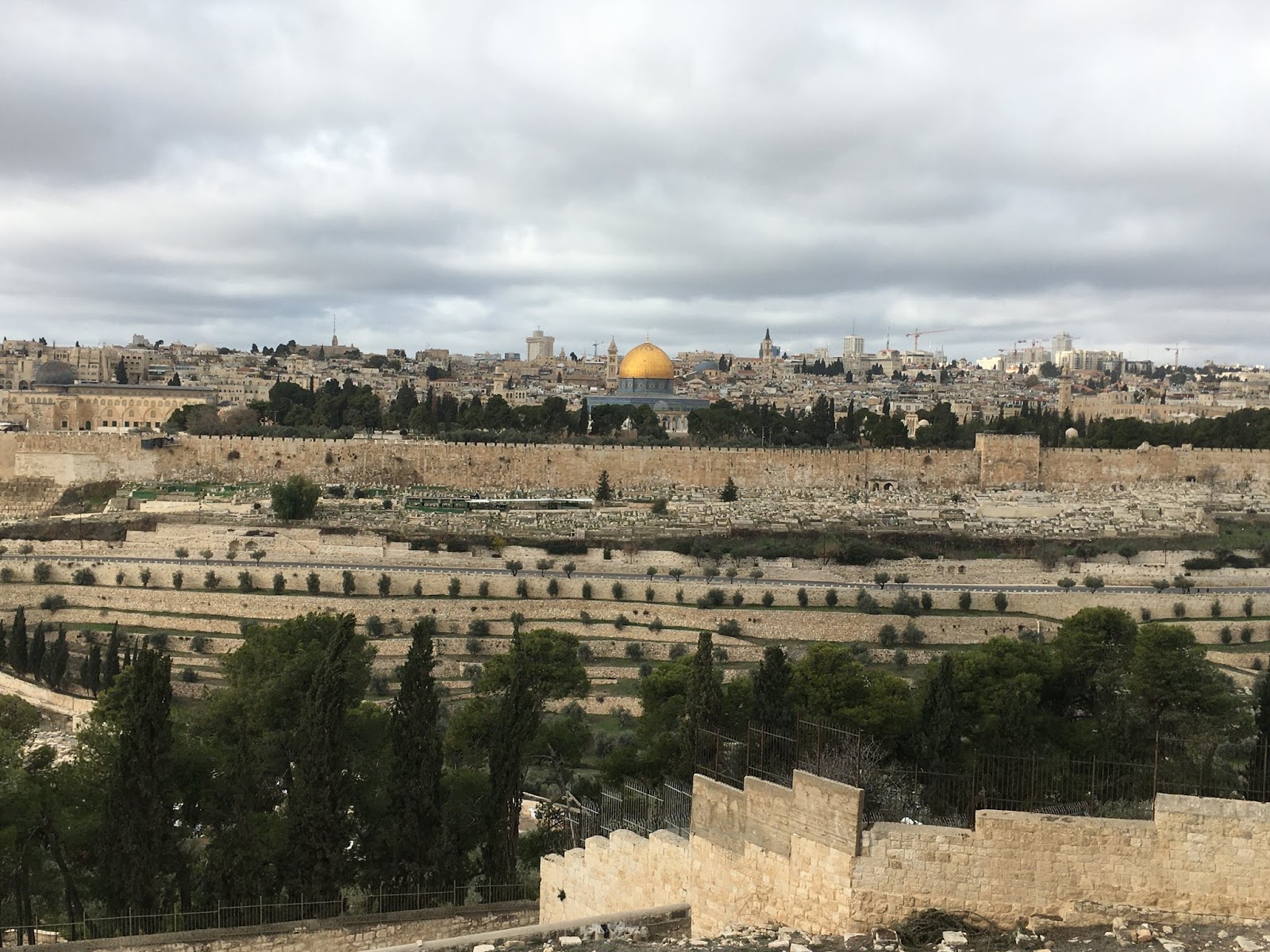
The golden Dome of the Rock, where Abraham prepared to sacrifice his son, Isaac; holy site in Judaism.

The Church of the Sepulchre is the grey dome immediately to the right of and behind the golden dome, and is the location of Jesus' crucifixion, burial, and resurrection; holy site in Christianity.

The grey dome is Temple Mount, the Nobel Sanctuary, where Mohammed ascended to heaven; holy site in Islam.

The Old City of Jerusalem, showing the close proximity of the three sites holy to the three, major, monotheistic religions.

The Church of Pater Noster, the site where Jesus taught his followers how to pray "Our Father"
An olive grove at the Church of Pater Noster, allowing one to imagine Mt. Olive during the time of Jesus.

At Pater Noster, "Our Father" is displayed in more than a hundred languages around the church.

Each unique in style.

Church of All Nations, in Gethsemane Garden, the site where Jesus prayed before his arrest.

The rock on which Jesus prayed in Gethsemane.


You can kneel and touch the rock itself. We were able to stay as long as we wanted.


Tuesday, January 7, 2020

Gathering

We arrived in Jerusalem a couple of days ago, and the greatest fun is running into cherished friends. The pilgrimage officially begins tonight at dinner, although pilgrims have been gathering together, trickling into Jerusalem on individual schedules and varied routes.

There are forty of us all together, and almost every person is a dear friend from our years of living in the Ananda Palo Alto community. Since moving away from the Bay Area eight years ago, we haven't spent much time with these friends, so this pilgrimage is especially meaningful, being able to spend extended time together with so many people that we love.

A walk back in time
We run into them in the hotel lobby, on the nearby streets, in the restaurant, and each new sighting is joyous and celebratory. This morning, a dozen of us gathered in the lobby at 5:30 to walk to the Church of the Sepulchre, twenty minutes away. Along quiet streets, with only an occasional early-morning car humming by, across empty intersections, and through a main entrance of a modern, high-end shopping mall. Walking through the elongated mall, with twinkly lights overhead and chic storefronts on either side, it was a journey through time, wending our way through cobbled passage ways, to emerge at the Jaffa gate to the old city. Just beyond, the high doors of the church beckoned us into a maze of passages, altars, stairs, balconies, tunnels, chapels, and alcoves. It seemed endless and somewhat bewildering.

And yet the quiet of the morning hours were gentle and serene. The first encounter was a stone slab, the stone on which Jesus' body had been anointed with oils, in preparation for placing him in the tomb, or sepulchre. Kneeling next to the stone, you place your hands, forehead, your heart onto the stone and imagine the sorrow with which they cleansed his broken body, binding it in its shroud, carrying it the short distance, measured in yards, really, to the tomb. Meditating at that stone, the site where the cross was wedged into its stone base is mere yards away in one direction, the tomb mere yards away in the other direction. It all happened in such a small area, it could have been a small, barren pasture, just there, there, and finally, there.

Pure devotion
A group of five exquisite singers gather each morning in St. Helena's chapel, around several interior corners and down two flights of stairs. Following each others' lead, we wound our way around and down to this small chapel, the site where St. Helena discovered the true cross, two or three hundred years after the crucifixion, just right there, below the foundations of the inner chapel that was once Jesus' tomb. The five voices blended together clear and pure, softly, devotedly, in harmony and rapture, transporting one's soul into inner light and beauty. We listened to them for perhaps a half hour, and then they were finished, kneeling in silence, then gently turning to gather their belongings and climb the stairs out into the dawn air.

We did not go into the sepulchre itself, out of respect for a tour group, then a full mass, then a long line of waiting visitors. Our hotel is so close by, we will go again and again, in the early hours, and find an even quieter day when we can linger and immerse ourselves in the sanctity of the sepulchre, the glory of the resurrection, and the worship from millions of devoted souls across centuries of time.

Our quiet walk back through the passageways, into the mall, back to modern times, out into the busier streets filled with commuters and bustle, back to our hotel and downstairs to breakfast, to gather together again with this friend, then that one, then newly arrived friends, then another. The pilgrims are gathering, and we will walk this holy journey together.

Farming with a Trowel

I was about six years old when I started tending my first garden. Even then, I loved pulling away the chaotic weeds to make room for orderly...