Friday, October 15, 2021

Planting Seedlings Early, Late, and Just in Time

There are times when two people cannot contribute enough hands to get the job done. We were extraordinarily blessed in the spring of 2021, when our friend, Dora, offered to come and help us get our planting beds up and running.

Dora at the prana table.

There were a few preliminary projects. We had to remove the bird netting, roll it up, tying each bundle securely, and stashing them away. Ditto for the landscape fabric, the twine, the fabric staples, the rocks, the branches.
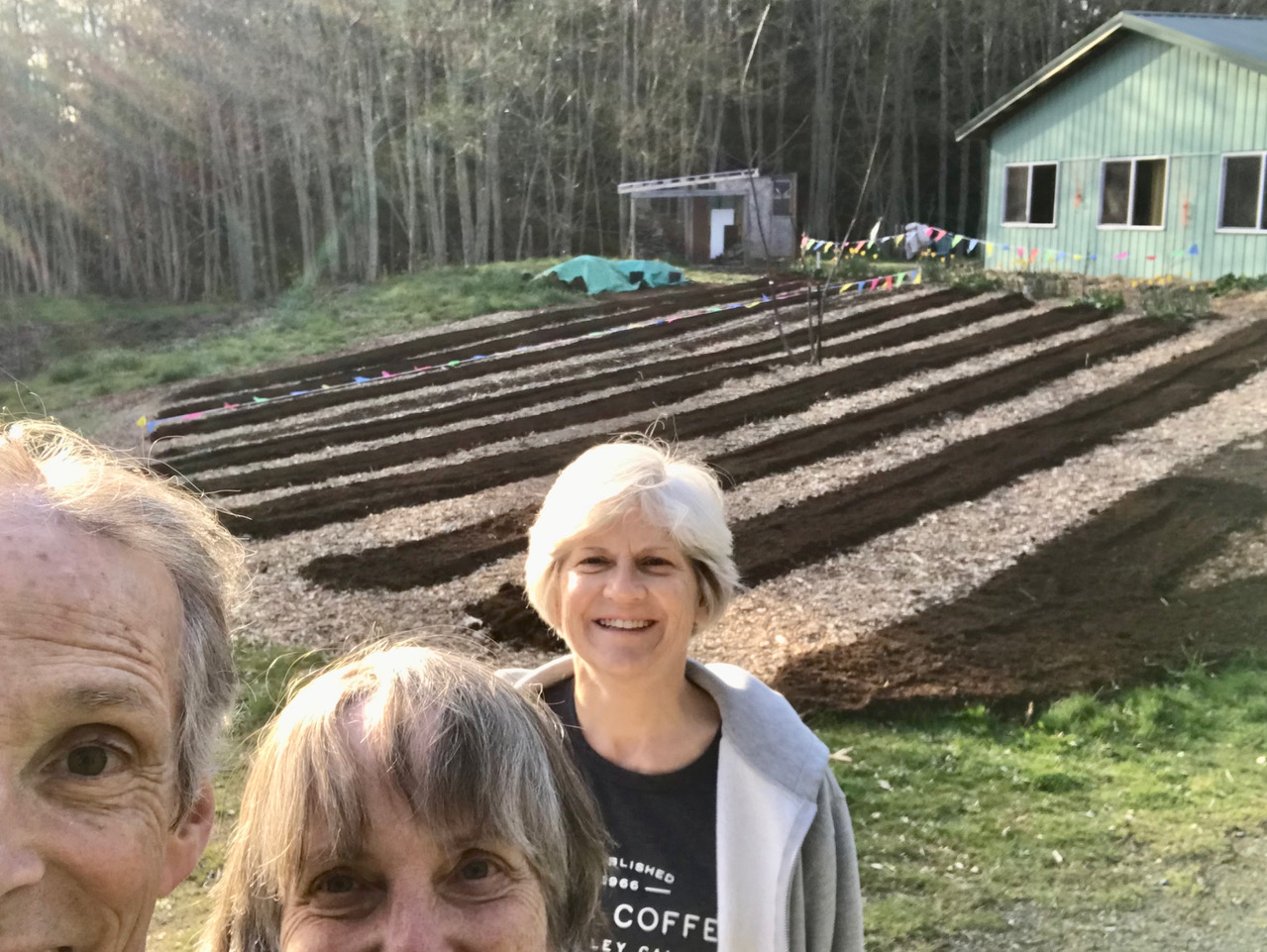
Our hard work paid off.


As we unzipped each bed, it seemed clear that our over-wintering strategy had worked. The beds were pretty much weed-free. We scattered some soil supplements and tilthed the top layer of compost, mixing everything together easily and neatly.


We had two types of seedling trays. We had set our sights on using a paperpot transplanter that we had inherited from a friend. In theory, we could transplant 256 seedlings in less than a minute. I had used it successfully in another garden and was enthusiastic about our success in getting all of our transplants into their beds.

Unfortunately, the straw underlayment had not broken down completely. It caught in the furrower of the transplanter, and hiccuped our progress into frustration and despair. Luckily, Dora and Dambara were able to persevere, and they got all of the paperpot seedlings into the ground.

We also had 50-cell tray seedings. Each seedling went into the ground as we scooted our way down the beds. With three of us scooting, we were able to get all of these seedlings into the ground as well.

We up-potted many of the seedlings, to allow them to gain size and resiliency before going into the ground. Especially the sprawlers, the squashes and cucumbers, would benefit by being older when they went into the ground, when the days and nights were warmer.

The veggie beds, a month into transplanting.
The three of us got it all done. But we had adversaries: one pint-sized and a trillion pea-sized.

The robin who owned our veggie meadow delighted in pulling up our fragile seedlings. He didn't eat them; he merely pulled and dropped them, gasping, at the cusp of their former lodging. He did this over and over, and we determinedly followed after him, replanting the gasping youngsters.

It was the trillions that worked faster than we could. Pill bugs. Trillions of them. They had overwintered, snug as a bug in a rug, under our brilliant solution of landscape fabric, feasting our our brilliant solutions of straw, compost, and wood chips.

We lost 90% of our onions, shallots, and leeks, and most of our spinach and lettuces. There were trillions of them. They didn't care for cilantro or arugula, asparagus or carrots, so we had many successes, too.

Flourishing flower beds.

Researching strategies for combatting pill bugs: Eliminate all decaying straw, wood, and compost. Well. Then we'd be back to native soil, so those strategies won't help. Spraying: Not part of our farming strategy. The one that would work: Transplanting older seedlings so they can outgrow the munch rate of the pillbug hordes. I'm thinking it will also help if we eliminate the winter covering of landscape fabric. That's a happy thought, since keeping the fabric in place was a huge pain last winter.


Transplanting older seedlings also eliminates the paperpot transplanter. That's actually okay, too, since that allows us to use straw again this winter to help further build our soil.

So. We learned a lot. We accomplished a lot. We conquered a lot. And if it hadn't been for Dora, it wouldn't have happened. Dora saved our spring and our farming year. Thank you, thank you, Dora. You are a jewel.

A jewel of a friend.

Tranquility.

Wednesday, October 13, 2021

Sowing Seeds to Build Our Farm

We were lucky enough to order our seeds in November, 2020. We had moved through the fearful covid year, with hope dawning in the new year. It was easy to think expansively.

I've grown plenty of veggies in my tenure as gardener, so those seeds were easy. And fun. I've not grown flowers, not many anyway, and only landscape flowers; never cut flowers.

Our main source of inspiration came from Floret Farm. They are only about 45 minutes from our farm, so what worked for them would surely grow on our farm as well. We downloaded their recommendations for the best cut flowers: Focals, spikes, disks, fillers, and airs. We ordered almost all of our seeds from Johnny's and some from Osborne. They all arrived promptly, and I promptly entered overwhelm.

So many seeds! So many varieties! So many colors, heights, support needs, germination times, dates-to-maturity times. I couldn't wrap my mind around it all.

Luckily, I'm a whiz with excel spreadsheets. I painstakingly entered all the relevant information about germination times, transplant-before-last-frost times, heights, and quantities. I let excel do all of the date calculations for me, and then I transferred the varieties onto another spreadsheet organized by weekly, calendar dates.

Everything fell into place. On the biggest sowing week at the end of February, I would have to sow 15 varieties. Other weeks would demand sowing of 5 or 6 varieties. With 7 days in a week, we would have to sow 2 varieties per day during that big week. Most weeks would need only 1 or 2 sowing days. This plan was completely feasible.


Every variety was new to me.

It was feasible in theory, and low and behold, it was also feasible in reality. Joyfully feasible. With our new greenhouse sheltering the growing expanse of seedling trays, my heart grew and expanded. As the seeds germinated, and the tiny seedlings lifted their faces to the warm sun filtering through the greenhouse panels, my heart quite simply exploded.

We opened the greenhouse doors every morning, helping the air stay cool under the spring sun. We closed it every night, helping the air stay still and safe under the spring moon. We watered the trays, seedlings dancing and jostling under the gentle spray. We pinched off stray weed seedlings. We started succession sowings of the seasonal powerhouses, both veggie and flower.

The window vents open and close automatically, according to air temperature.

Our plan was working. Our greenhouse was working. The sun was working. The seedlings were working. Our farm was beginning.

Our self portrait.


Monday, October 11, 2021

A Greenhouse to Withstand the Winds

Creating a small-scale farm in the Pacific Northwest requires creating a greenhouse. The cold of winter lingers. The chill of spring lingers. Then the warmth of summer hits full force, with long days and temperate nights, and then all too soon, the cool of fall descends, and another farming season coasts to an end.

A greenhouse lets us start seeds early, early, early. We can get seedlings going and keep them happy in the daytime warmth of a greenhouse for several weeks. Once we pass our last-frost date, these happy seedlings can go into the ground and turn their faces to the warming sun and burst into serious chlorophyll production.

Original greenhouse site, by the blue tarp.

We had originally planned to build our greenhouse down by the veggie beds. We wanted it to be a pretty greenhouse, so nestled amongst the veggie beds, we would see it whenever we glanced out our windows. And it would be right there! Short trip from greenhouse to planting beds. Made so much sense.

But our planting beds are bordered by mature trees. We realized that the greenhouse would be in the shade by 2:00 in the afternoon during the spring months, those all-important months when the fragile seedlings would need all the light and warmth the greenhouse could muster.

Improved greenhouse site; flat and sunny.

So we changed plans midstream. We relocated the greenhouse site up near our shop, where the ground was super level, and the trees were a considerable distance to the east and west. Our pretty greenhouse would greet friends and neighbors when they came to visit. We could still see it from our windows; we just had to peer a bit.

We have considerable winds on our island. Two or three times a year, storms can bring winds that howl across our property at 50-60 mph. We also get a little snow, so snow load could be a factor. We chose a model that was sturdy enough to withstand our winds and shaped to slough snow.

It was expensive, about $5,000. But I just happened to land an editing gig that would cover the cost. We took the plunge. We had to have a greenhouse if we wanted successful planting beds, and the universe gave us the means to procure the perfect one. We clapped our hands with glee.

We drove two hours to pick up our new greenhouse and they piled and stacked and wedged it into our 20-foot RV. It came in flat packages. It barely fit inside our RV. It had thousands of screws and hundreds of pieces, and they all had to go together just so.

The instruction booklet was sparse and vague. The instructional videos weren't very instructional. We're not builders, but we're pretty clever. We got it figured out, and we finally, finally got it built.

Gravel and crushed-stone pad

Help from our friends.

A ways to go.

The marketing information claimed that two people could build the greenhouse in two days. It took us all of January. ALL of January. We laid down gravel. We laid down crushed rock. We scrutinized, read, videoed, experimented, put together, took apart, climbed ladders, scooted on our knees. One of us came to tears several times. One of us stayed calm and cheerful. We persevered, and we finally, finally got it built.

Thousands of screws, with tension pulling in several directions.

Light at the end of the tunnel.

Our farm cooperative, gathering to ooohh and aaahh.

Busily growing seedlings.


Never, never have I ever, ever had such a wonderful venue for sowing seeds, peering at germination, watering seedlings, crooning, and grinning. The greenhouse made our farm possible. I am in joyful love with our pretty, enduring, nurturing greenhouse.


Ready to grow a farm.

Friday, October 8, 2021

Flower Beds

As we finished up the planting beds that we laid out in the pasture to the west of our house, I began counting on my fingers. These beds were huge, in my experience, but our list was huge-er. Where would we put the flowers?

An easy glance over our shoulders offered the obvious solution. Our shop was situated on the opposite side of a gully from our house. Between the shop and the gully was a gentle, south-facing slope that was obviously perfect for flower beds. They would get so much sun. We would see them from our windows. They were right next to the shop, which housed our tools. There were two water-hydrants already in place. It was obvious.

The obvious choice.

I was at a loss as to how to orient the flower beds. How wide? Which direction? How many? I brainstormed with friends and husband, staring at the slope from our deck, imagining. It wasn't obvious.

Then, one sunny winter day, I walked along the slope, along the edge of the shop, along the driveway. I got out some stakes, twine, and a hand sledge and started marking off a pathway along the shop, wide enough for frequent foot and cart traffic. I marked off the slant of the gorge, the stretch of driveway, the most direct route between house and shop. It all became obvious.

We could fit nine beds on that slope, 45 feet long, which echoed the length of our first set of beds, and 3 feet wide, for ease of flower harvesting. The paths could be narrow, since these flowers wouldn't sprawl. We'd trim back the maple tree that did sprawl across the center of our slope. It all took obvious shape.

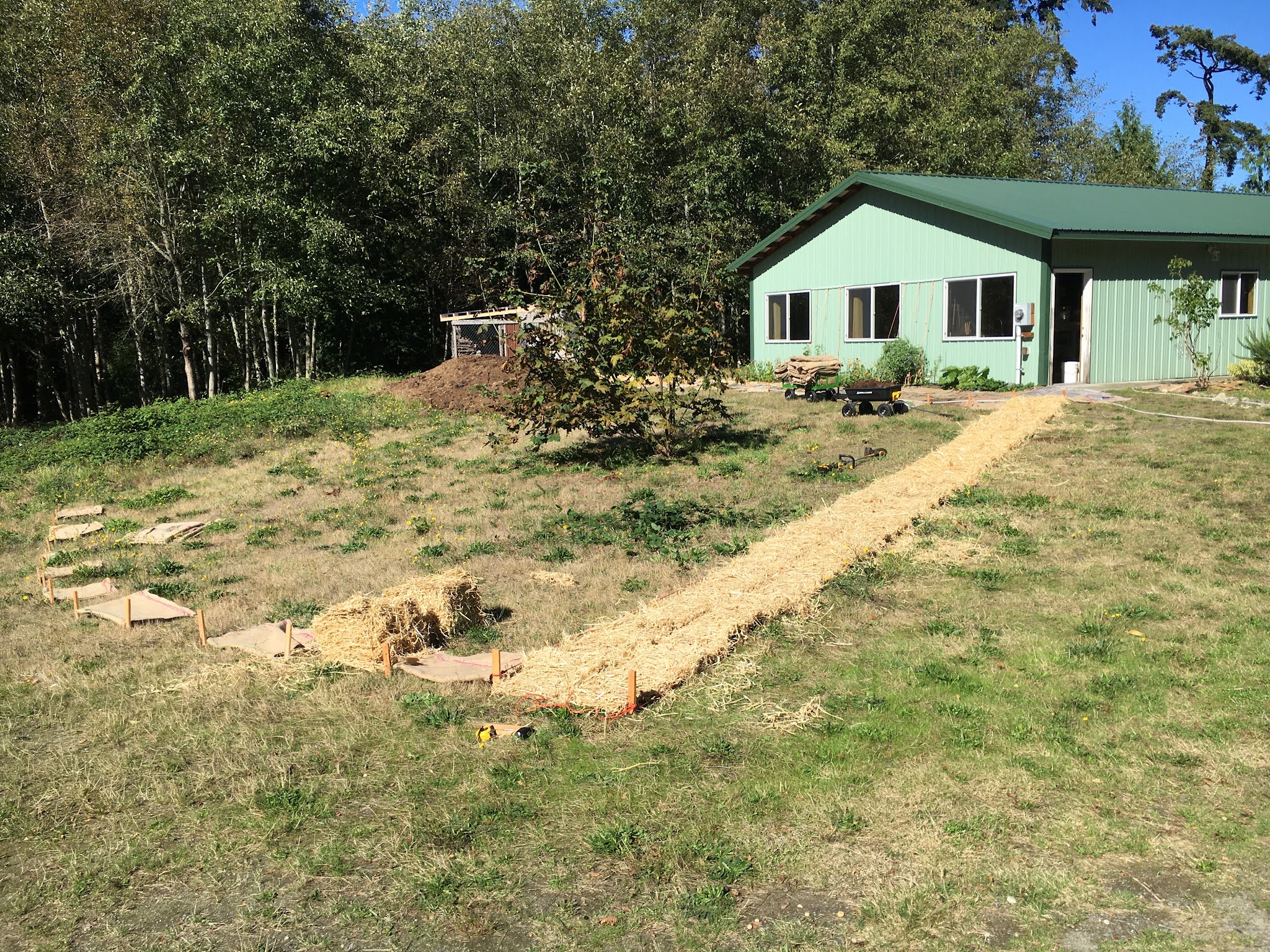
We ordered more straw and dairy compost and mowed the pasture grasses and weeds that had crammed themselves onto that gentle slope. We dealt out the compacted straw pads, spread 5-6" inches of dairy compost, covered with fabric cloth, bird netting, and zigzagged twine, and stepped back to take a look.

A direct path between house and shop.

Laying down straw, topping with compost.

The diagonal layout dictated by the gorge left a large, empty triangle next to the driveway. We could put perennials there.

We spread cardboard, burlap bags, and wood chips, and left the flower beds to work on their winter steeping.

Fabric, netting, and burlap in place for the winter.

Wood-chip paths and tilthed beds in the spring.
The triangle bed completes the layout.
With 14 veggie beds steeping to the west of the house and 10 flower beds steeping on the shop's slope, we were ready for spring.

Wednesday, October 6, 2021

Chipless on Camano

 Our small farm is on the south end of Camano Island, making it a bit far for some professionals to make the trek. That includes arborists and all ranks of tree-tenders. It's hard for us to get wood chips.

Being a no-till farm, chips are a vital ingredient, providing coverage for walkways throughout our planting beds. Being a no-till farm, we add straw and compost on top of the native soil and build UP. Chips add height to the pathways, stabilizing the edges of the beds. Straw, compost, and chips create amazingly bountiful harvests.

Now, we could buy chips from a nursery or landscape supply business, but it's hard to fork out $400 - $500 for a load of chips knowing that they are available for $0 - $25 a load. Plus, we're on a tight budget, living on a fixed income, so practicality dictates that we spend money when we have to and save money when possible.

A local tree-trimming business did drop off one load, but they admitted that we were just too far away to make it practical for them to drop off more, even with a cash incentive. But we did get one load! That was a huge step forward.

How to make up the difference? We needed a second load.

Dambara, my husband, spent most of the winter months uplimbing the mature trees that encircle our property and taking out the tangle of smaller trees, bushes, and, you might have guessed this, brambles. A Pacific Northwest staple, those brambles. I'm in love with them for about 5 weeks each fall, when they offer up those delectable berries, but their prolific nature pushes them to invade every inch of land possible. So, Dambara has worked and worked, taming them back into a reasonable, manageable form.

. . . to this.
From this. . .
In the process of uplimbing and clearing, Dambara created two, gigantic mountains of brush. Enormous piles, stretching about 50 feet, 5 feet high, and probably 15 feet wide. Enormous. We joined forces with some local friends and rented an equally enormous chipper for a week, and we got to use it for three entire days.

To get this.

Three days was enough time for us to chip our way through those enormous piles, shooting the chips into the back of a friend's pick-up truck, and dumping them into the middle of our garden plot. From there, we wheelbarrowed them onto each pathway and spread them out with a rake. We laid down cardboard first, as a weed block. We covered the cardboard with burlap bags, to stabilize the layers.

To get . . . Chips!!!

That cardboard was a godsend come spring and summer. Our weed burden was minor. Minorly minor. We could pull weeds throughout our entire garden once a week, taking about a half an hour for the entire garden plot. Cardboard is a small-scale farmer's best friend.

Victory.

So, we conquered the chip challenge. Stage Two chip-challenge is approaching, since we'll add another layer of straw and compost to the planting beds, necessitating another 2" - 3" layer of chips in the walkways. We're on the list for chip-drop, so wish us luck. We can conquer the world with just two loads of chips.

Monday, October 4, 2021

Camano Winds

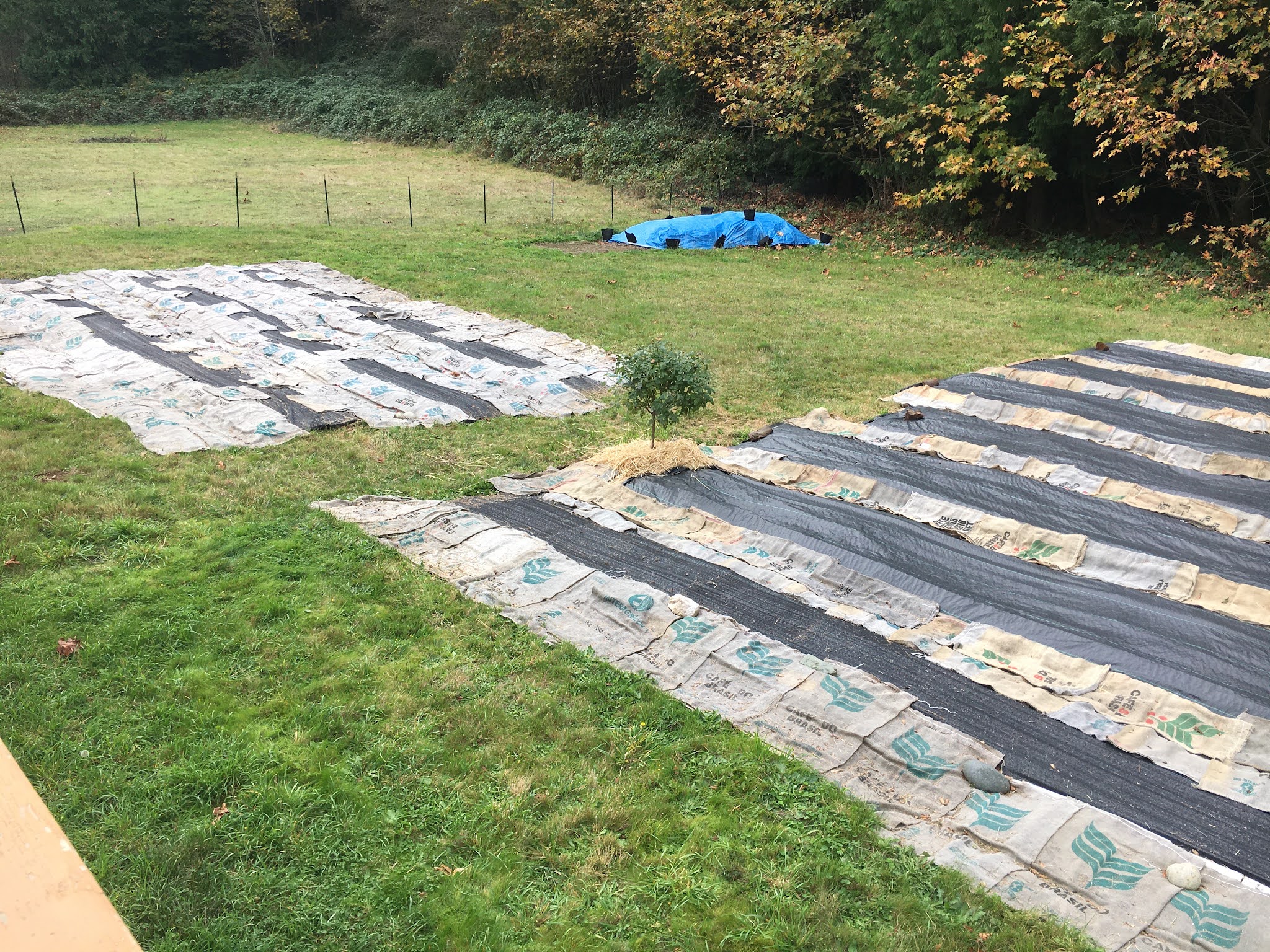
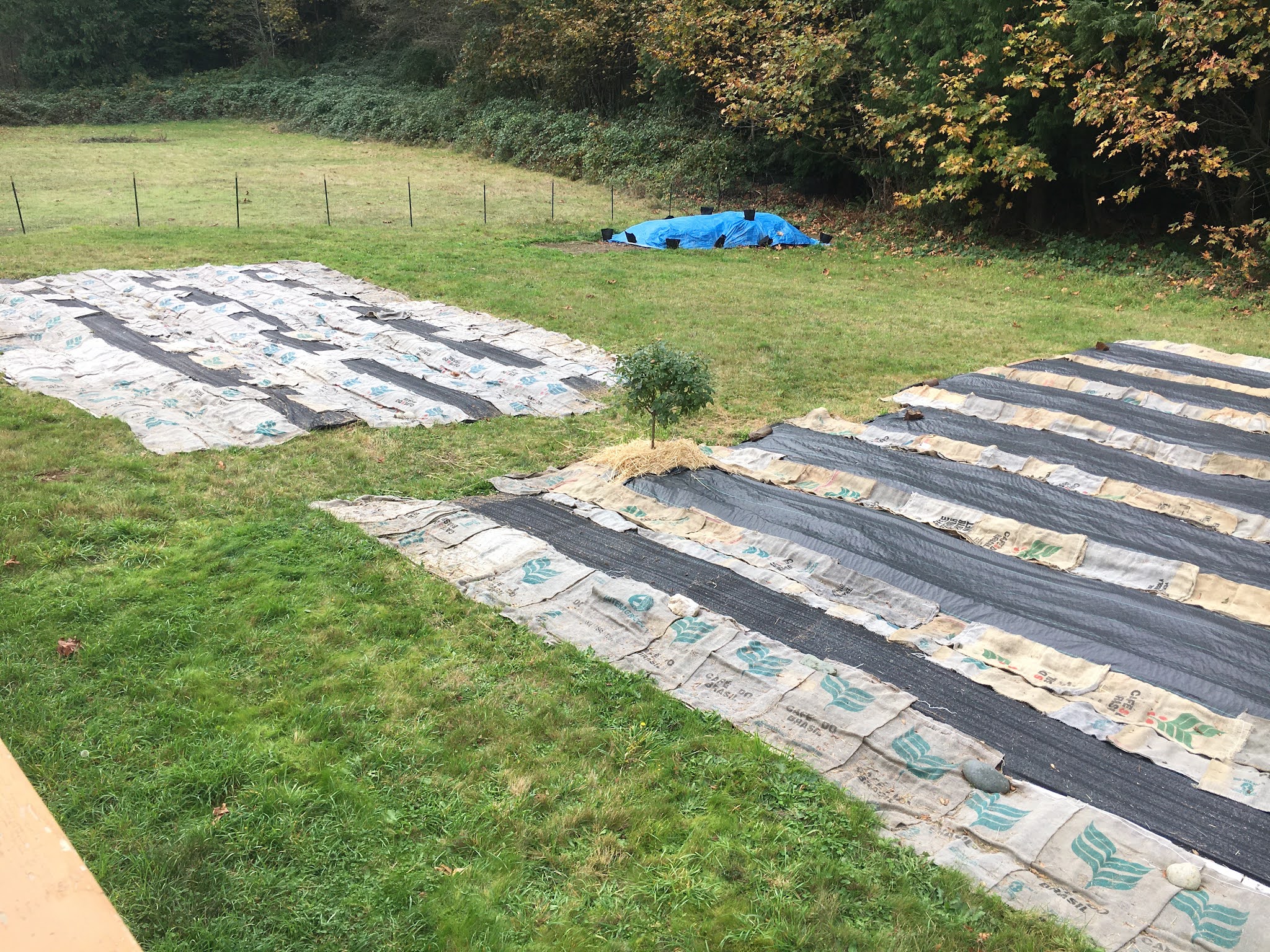
We felt great about our ten planting beds. We were way ahead of the game by building them in the fall and letting them steep until spring. We'd be weed-free, since all the beds were covered with sturdy landscape fabric. Rain could get in, but weed seeds would bounce along to another destination, and any stray seedlings would languish under the black fabric.

So neat. So tidy.

Time for a cup of tea and a comfy chair.

Ha!

Fall winds wound up, the warm-up act for winter winds. Almost every morning a glance out the windows showed us that the tea and comfy chair weren't quite within reach.

We tried everything. We placed large rocks along the edges of the landscape cloth. The wind snuck under the cloths between the rocks and shuddered the cloth from under the rocks. Ten beds at 45 feet each adds up to 900 feet of fabric edge. We moved so many rocks so many times it got the better of us.

We tried thick branches, left over from uplimbing the perimeter trees. Each branch could secure 10-15 feet of fabric edge, enormously reducing the number of rocks we had to move. The fabric escaped, flew in circles, and tangled itself around the limbs.

We added burlap bags under the rocks and limbs. The burlap would stay wet and heavy from the rain and weigh down the entire edge, reinforced by the weight of the rocks and limbs. We hunted down a lot of burlap amongst the trees edging our beds, relaid them, rerocked and relimbed them, and thought fleetingly of tea and comfy chairs.

The fabric would. not. stay. put.

We zigzaged lengths of twine across the beds, relaid the burlap, rerocked and relimbed the burlap. Nope. The cloth still shuddered and jittered as the Camano winds sped merrily overhead. The fabric snuck out from all of its assorted restraints and wrapped itself untidily around nearby bushes and trunks.

The trick that finally worked was bird netting. We straightened all the lengths of fabric . . . again. . . stretched bird netting from end to end, stapled the netting down and threaded the twine zigzaggedly, end to end, AND put a rock on top of each staple to keep it in place. We added the limbs, because, why not? Our sandy sand doesn't provide firm anchoring for landscape staples, so they needed help staying in the ground.

The wind could no longer quite get the fabric-dance going. It zipped along the beds, causing barely a ripple. We peered out windows each morning, let out our breaths, and grinned. The planting beds could finally start their winter steeping, and we could brush the cobwebs off the comfy chairs, the steam drifting from our steeping cups. The quiet season had begun.

The quiet season.


Friday, October 1, 2021

First Beds

Our new house was surrounded by pasture, pasture that had been mowed and mowed and mowed. Underneath the over-mowed pasture was sandy sand. Our native soil can't hold water, can barely support grasses and pasture weeds, and is full of rocks. Luckily, most of the rocks are friendly, being smallish and round; leaden ping pong balls, snuggled into their bed of sandy sand.

Not much can grow in this native soil.

25 yards makes a huge pile.

There's a roadside sign along the highway as you drive onto our island. "Garden compost, $15/yard." Feeling adventuresome, we called the number, and sure enough, our local dairy farmer would bring his dump truck to our property, filled to the brim with 25 yards of dairy compost.


There was hope.


Lovely, lovely straw, ready to become soil.


Another local source delivered 20 bales of straw. We had the makings of healthy soil that would feed the microbes and worms and an entire universe of burrowing beings. We rolled up our sleeves.


This bounty arrived mid-summer. We had visions of a fall garden, burgeoning with cabbages and squash and onions. We were ready.

However, the dairy compost was hot. The high nitrogen would cook any tender seedlings we handed over to its care.

Undeterred, we refocused our lens and looked toward spring. We pried apart pads of compacted straw from each bale, nestled them cheek-by-jowl onto our newly mown pasture, creating ten beds, 4 feet wide and 45 feet long, with a wide central walkway.

The planting beds take shape.


Ten beds, leaving room for a greenhouse.


We carted our hot compost and piled it, 6 inches deep, onto the 5 inches of straw pads, and watered it all down.


Our hopeful scheme for keeping the landscape cloth in place.

To deter fall weed seeds from setting up house on these inviting stretches of richness, we covered each bed with landscape cloth, holding the edges down with burlap bags.
It looked a mess, but we knew that each bed would cook over the winter and be ready for spring planting in just a few months.


In the meantime, we needed worms.

Build it, and they will come.

They did. In droves.

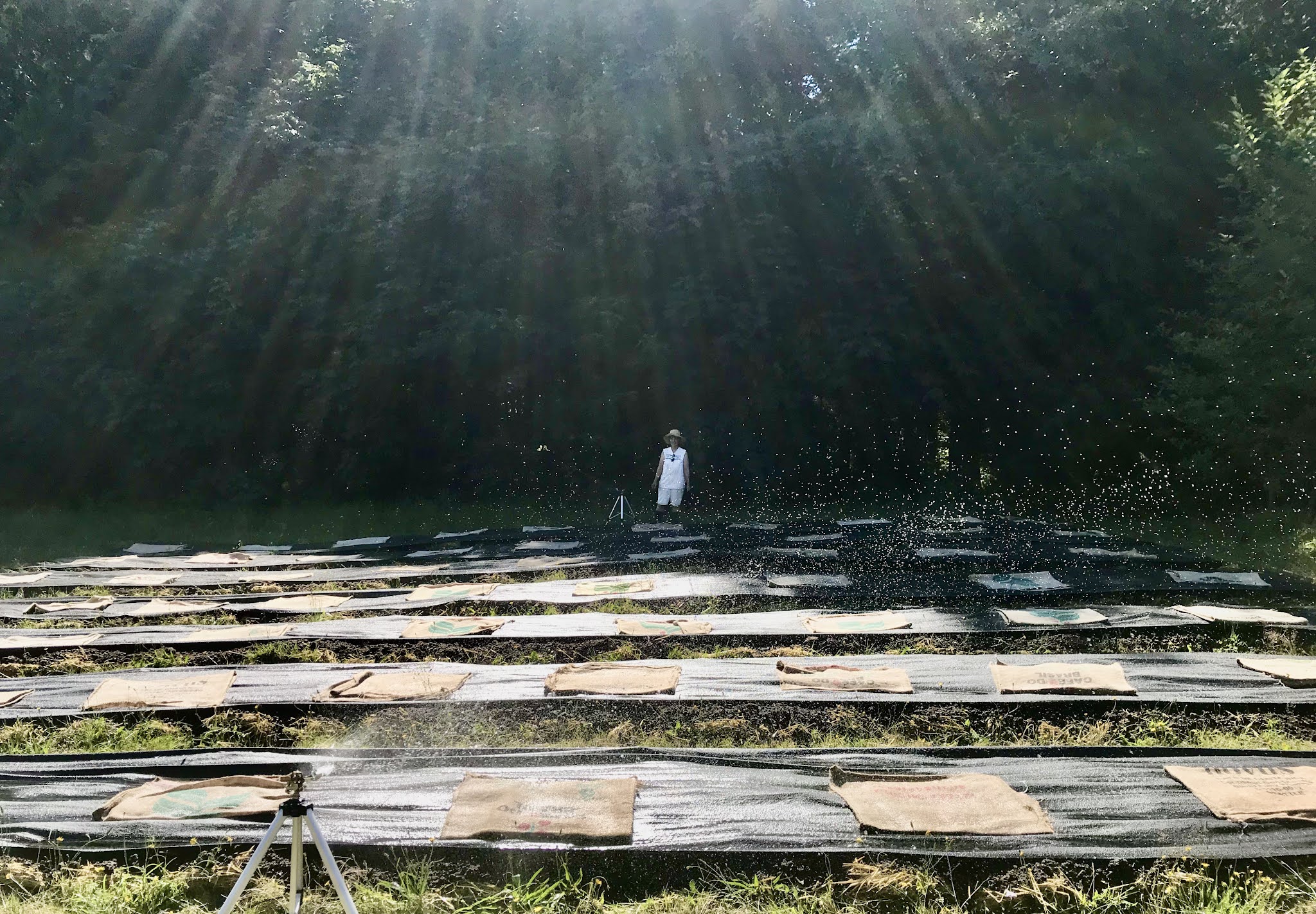
The first watering.

Farming with a Trowel

I was about six years old when I started tending my first garden. Even then, I loved pulling away the chaotic weeds to make room for orderly...